3 Habits Home Gardeners Need to Keep Basil Flavorful and Disease Free
Basil needs warmth, full sun, well-drained soil, careful watering at the soil line, and routine pinching to stay productive. Move your plant to a spot with direct light, switch to watering the base instead of the leaves, and start pinching stems once you see six true leaves. Get these three habits right and everything else, from flavor to disease resistance, tends to follow.
TL;DR:
- Proper watering at the soil level and ensuring 6 to 8 hours of direct sun are crucial for maintaining basil’s flavor and health.
- Using resistant cultivars labeled DMR can help reduce downy mildew risk but does not guarantee complete immunity due to environmental influences.
- Regular pinching above the second set of leaves and harvesting only 75% of the plant prevents legginess and encourages dense growth.
- Indoor growers should supplement with grow lights for 10 to 12 hours daily to replicate outdoor flavor production.
- Consistent soil pH between 6.0 and 6.5 and avoiding overwatering or poor drainage significantly improve basil’s growth and disease resistance.
Table of Contents
- Basil care checklist for planting and daily maintenance
- When and how to plant basil for the best start
- How much light and warmth basil needs for good flavor
- Getting the soil, pH, and feeding schedule right
- Watering basil the right way in beds and containers
- Pinching and harvesting basil to keep it productive
- Preventing basil downy mildew and other common pests
- Propagating basil from cuttings and repotting containers
- How to preserve harvested basil without losing flavor
- Fast fixes for the most common basil problems
- How Viridia adds a layer of support to basil care
- What actually matters most in basil care
- An easier way to stay on top of basil care
- Sources
- FAQ
Basil care checklist for planting and daily maintenance
Basil rewards consistency more than effort. This checklist covers the timing and rhythm that keep plants productive from spring through fall.
- Planting window: sow indoors when soil temperatures reach 60 to 70°F, or transplant outdoors after all frost risk has passed.
- Light: give basil 6 to 8 hours of direct sun a day, more if grown indoors under lights.
- Watering cue: check the top 1 to 2 inches of soil and water only when it feels dry.
- Pruning cadence: pinch stems back every 2 to 3 weeks once the plant has six true leaves.
- Containers: check soil moisture daily in hot weather since pots dry faster than garden beds.
- Preservation: freeze leaves for the best flavor, since drying tends to dull basil’s aromatic oils.
When and how to plant basil for the best start
Basil can start from seed or transplant, and the choice mostly comes down to patience. Seeds germinate best at 60 to 75°F and typically emerge within 5 to 14 days, according to Iowa State Extension. Starting seeds indoors 4 to 6 weeks before your last expected frost gives seedlings a head start, and keeping them under bright light prevents the leggy, weak stems that come from low light.
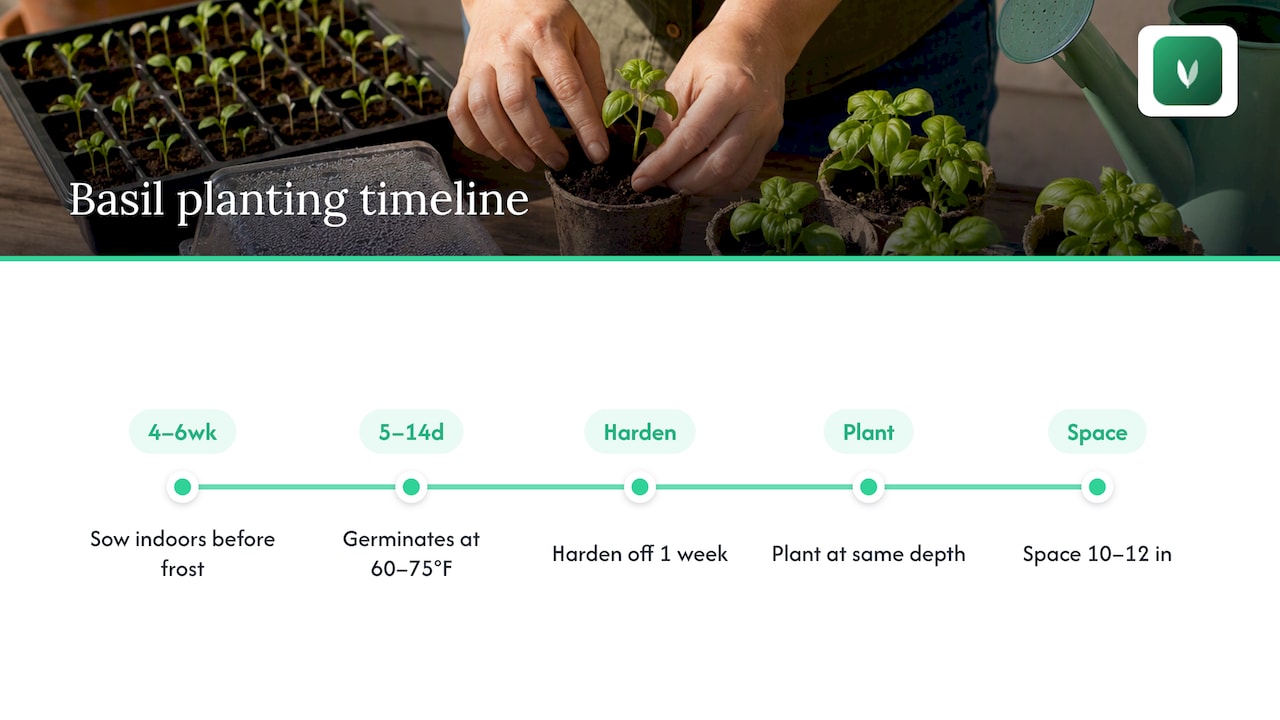
Transplants need hardening off, meaning a week of gradually longer stints outdoors before they go into the ground full time. Space plants 10 to 12 inches apart to allow airflow between them, and plant at the same depth they were growing in their containers.
Variety choice matters as much as timing. Genovese suits classic pesto, Thai basil brings anise notes to Southeast Asian dishes, and lemon basil works well in drinks and salads. If downy mildew has been a problem in your area, look for cultivars labeled DMR, which stands for downy mildew resistant. Resistant cultivars provide an important layer of protection, though a peer-reviewed model of basil resistance notes that genetic background, plant age, and environmental conditions all affect how well that resistance holds up, so no variety guarantees complete protection against evolving pathogen strains.
How much light and warmth basil needs for good flavor
Basil is a sun lover, and skimping on light shows up directly in taste. Aim for 6 to 8 hours of direct sun daily, since NDSU Extension notes this range as basil’s baseline requirement. Less light means less production of the aromatic oils that give basil its characteristic flavor, so a plant tucked into a shady corner will grow but taste flat.
Basil is also unforgiving of cold. Don’t plant outdoors until frost danger has fully passed, and protect plants from temperatures below roughly 40°F, which can damage leaves even without a hard freeze. In climates where summer afternoons regularly push past 90°F, a little afternoon shade prevents wilting and leaf scorch without sacrificing the morning and midday sun the plant needs.
Indoor growers face the opposite problem: not enough light rather than too much. A south-facing window helps, but most homes don’t provide the intensity basil wants year-round. Supplementing with grow lights for 10 to 12 hours a day gets indoor basil much closer to outdoor flavor, according to UConn Extension’s greenhouse guidance, which notes that indoor-grown basil often develops weaker flavor without strong supplemental light.
Getting the soil, pH, and feeding schedule right
Basil grows best in soil with a pH around 6.0 to 6.5, slightly acidic to neutral. A basic soil test kit will tell you where you stand: if the pH runs low, garden lime raises it, and if it runs high, elemental sulfur brings it down. Either amendment takes weeks to shift pH meaningfully, so test early in the season rather than after problems appear.
Drainage matters just as much as the nutrient content. Heavy clay soil holds water around the roots and invites rot, so work in compost to loosen the texture and improve drainage before planting. For containers, use a quality potting mix rather than garden soil, which compacts too easily in a pot.
Feed basil sparingly. A liquid fertilizer at half strength every 3 to 4 weeks outdoors, or every 4 to 6 weeks indoors, is enough to keep plants productive, per NDSU’s guidance. Heavy nitrogen feeding pushes fast, leafy growth at the expense of the essential oils that carry basil’s flavor, so more fertilizer is not better here. If your soil already has organic matter worked in each season, you can often skip supplemental feeding for container plants that are repotted with fresh mix.
Watering basil the right way in beds and containers
Basil wants consistent moisture without soggy roots. Check the top 1 to 2 inches of soil and water only when that layer feels dry, rather than watering on a fixed schedule. Direct water at the base of the plant instead of overhead, since wet foliage is one of the main conditions that lets fungal diseases take hold.
Drip irrigation or soaker hoses are the most reliable way to keep water at soil level, and morning watering gives any splashed leaves time to dry before evening humidity sets in. If you’re setting up a new irrigation line for the season, following proper seasonal start-up steps, as outlined by Wallers Plumbing and Heating, helps avoid leaks or pressure issues before you rely on the system all summer.
Containers dry out faster than garden beds, sometimes within a single hot day, so check potted basil daily once temperatures climb. Choose a pot at least 8 to 12 inches wide to buy some buffer against rapid drying, and repot once roots start circling the bottom or growth visibly slows. In garden beds, a 2-inch layer of mulch around the base helps stabilize soil moisture and cuts down on how often you need to water.
Pinching and harvesting basil to keep it productive
Basil rewards regular cutting. Start pinching once seedlings have six true leaves, and keep the rhythm going all season with these steps, based on Clemson HGIC guidance:
- Pinch the stem back to just above the second set of leaves to force two new branches where there was one.
- Repeat this pinch whenever a branch reaches 6 to 8 leaves, which keeps the plant bushy instead of leggy.
- When harvesting, always leave at least 4 to 6 inches of growth, or 2 to 4 sets of true leaves, above the soil so the plant can recover.
- Harvest up to about 75% of the accessible growth at a time, never stripping the plant bare in one pass.
- Remove any flower buds the moment you spot them, since flowering signals the plant to stop putting energy into leaves.
Pro Tip: If a plant gets leggy and thin mid-season, a hard prune back to a strong pair of leaves will push it to fill back out within a couple of weeks.
Preventing basil downy mildew and other common pests
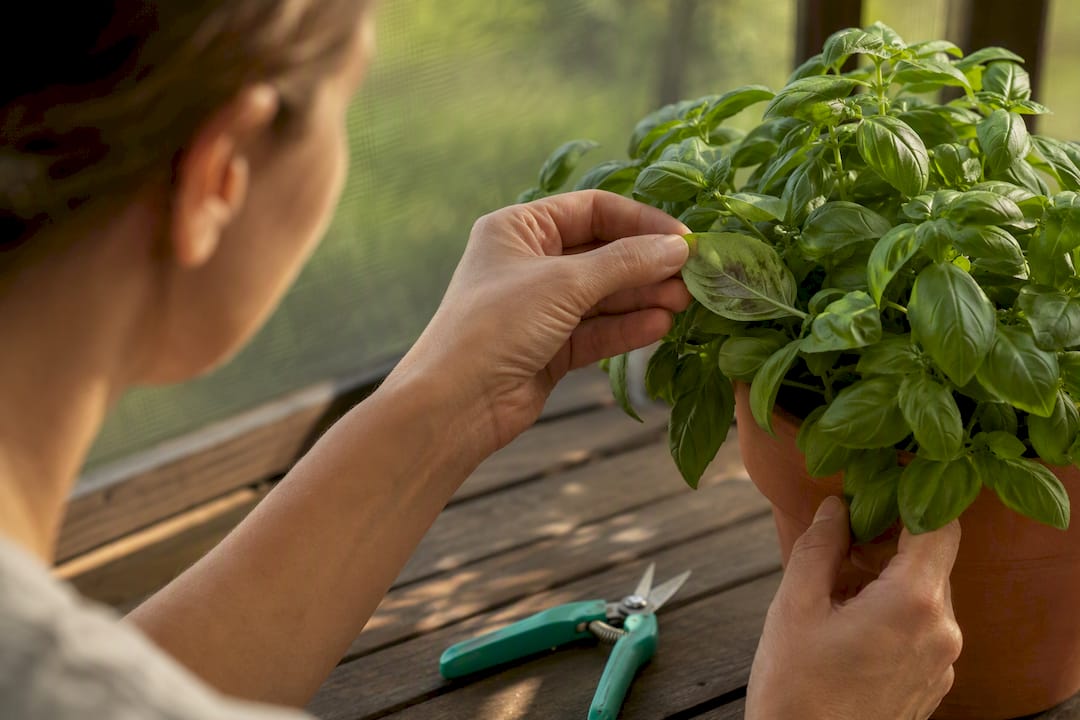
Basil downy mildew is the disease most likely to wreck a season’s harvest, and catching it early makes the difference between a manageable setback and total loss. Watch for yellowing between the leaf veins on top, paired with a gray or purplish fuzzy growth on the underside, especially after humid weather. According to UConn Extension, humidity above roughly 85% combined with poor air movement accelerates spore germination, and infected plants can suffer complete yield loss.
Micronutrient treatments have been shown in trials to significantly reduce downy mildew severity by a substantial margin, according to research on manganese and zinc applications, which found reductions of 46 to 71% and sometimes over 50% when applied through irrigation. That said, cultural prevention should always come first, with micronutrient treatments reserved as a supplemental measure for stubborn outbreaks.
Build your prevention routine around these steps:
- Water at the soil line in the morning, never overhead, to keep foliage dry.
- Space plants generously so air moves freely between them.
- Remove any infected plant immediately and discard it in the trash, never in the compost pile.
- Choose DMR-labeled or resistant cultivars, since resistant genetics remain the strongest long-term defense even though no variety is fully immune.
Beyond downy mildew, basil deals with the usual garden pests: aphids clustering on new growth, slugs and snails chewing ragged holes, and thrips leaving silvery streaks on leaves. A strong spray of water knocks back aphids, hand-picking works for slugs, and insecticidal soap handles most infestations without resorting to harsher chemicals.
Propagating basil from cuttings and repotting containers
Basil roots easily from cuttings, which makes it simple to multiply a favorite plant or start a new batch mid-season. Cut a 4 to 6 inch stem section that includes at least one node, since that’s where the rooting activity concentrates and stems cut without one tend to rot instead of root. Place the cutting in a glass of water or directly into moist potting mix, and expect roots within about 1 to 2 weeks.
Repot when you notice roots circling the bottom of the container or when growth slows despite good light and water, both signs the plant has outgrown its space. Move up one or two pot sizes rather than jumping to something dramatically larger, which can leave roots sitting in more soil moisture than they can use. Whatever tool you use to take cuttings or trim roots, clean it first, since dirty blades are an easy way to spread disease between plants.
How to preserve harvested basil without losing flavor
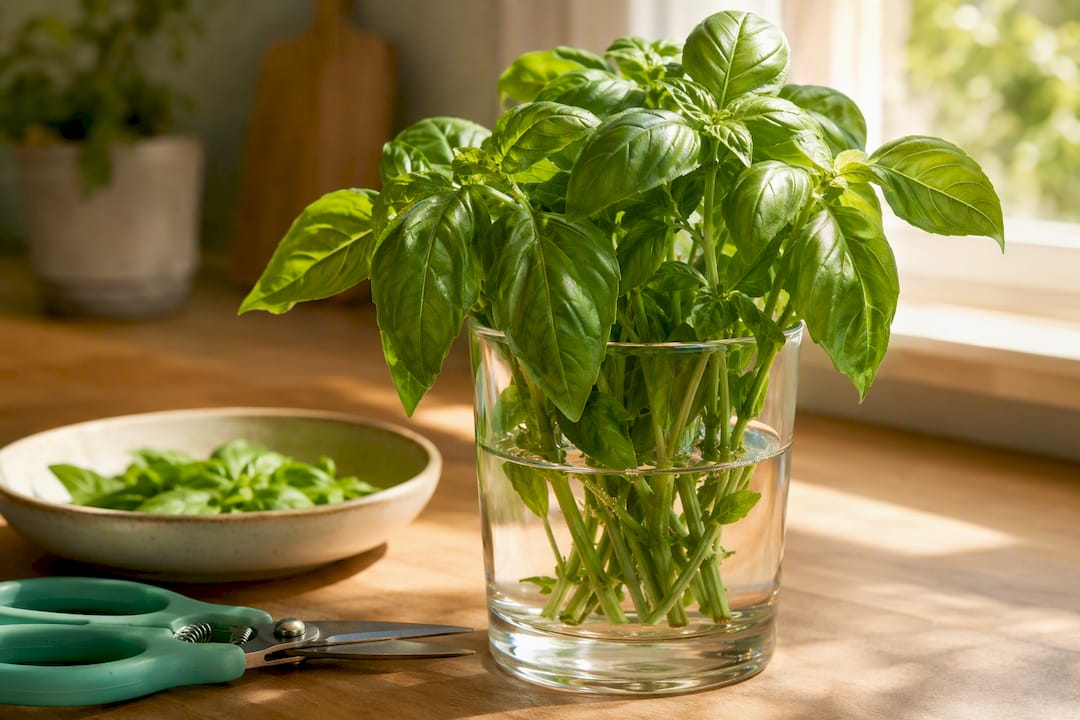
Fresh-cut basil is delicate, and how you handle it after harvest matters almost as much as how you grew it. For short-term storage, treat stems like cut flowers: stand them in a glass of water at room temperature rather than refrigerating them, since cold temperatures quickly damage the leaves.
For longer storage, freezing beats drying on flavor and color, according to NC State Extension. Freeze whole leaves in an airtight bag, or blend leaves with oil or water and pour the purée into ice cube trays for easy portioning later. If you do dry basil, use low heat and store the dried leaves in an airtight, dark container, but expect a noticeable drop in aromatic intensity compared to fresh or frozen.
Fast fixes for the most common basil problems
Most basil problems trace back to one of a handful of causes, and the fix is usually quick once you know what to look for.
- Yellowing leaves: usually a sign of overwatering, so improve drainage and cut back watering frequency.
- Wilting in heat: water deeply at the soil line and add afternoon shade for container plants.
- Bolting or flowering: pinch off buds immediately and harvest more often to slow the process.
- Weak flavor indoors: boost light intensity or add supplemental grow lights to close the gap with outdoor sun.
How Viridia adds a layer of support to basil care
Viridia identifies your basil from a photo, tailors care tips to your specific climate and soil, and flags health issues before they spread. For basil growers, that means earlier detection of downy mildew symptoms, watering reminders timed to avoid wet foliage overnight, and pruning schedules that adjust automatically. You can see how this works on the Viridia basil plant page.
What actually matters most in basil care
Chasing one giant harvest misses the point. Frequent, moderate cutting keeps plants productive all season and produces better-tasting leaves than letting a plant grow untouched until a single big pick. I’d rather see a home gardener prune often, prevent disease through spacing and morning watering, and try two or three varieties than chase a single perfect crop.
— Dan
An easier way to stay on top of basil care
Between watering cues, pruning cycles, and disease watch, basil asks for more attention than most herbs, and it’s easy to miss an early symptom or a missed pinch during a busy week.

An AI garden assistant app covers basic plant identification and care tips in its free version. It offers personalized health diagnosis, recovery tracking, and climate-tailored reminders in its paid Premium plans and a one-off Founding members option for early adopters. For basil specifically, this includes features such as photo-based diagnosis of potential health issues, reminders suited to the local climate for proper watering practices, and a maintenance calendar to help keep pruning and harvesting on schedule.
Check the current plans on the Viridia landing page and see what fits your garden.
Sources
- HGIC: Basil (Clemson)
- UConn Extension: Basil downy mildew
- Predicting resistance of basil to downy mildew (peer-reviewed)
FAQ
How do you trim basil so it keeps growing?
Pinch stems back to just above a set of leaves once the plant has six true leaves, and repeat whenever branches reach 6 to 8 leaves. Always leave at least 4 to 6 inches of growth above the soil so the plant has enough left to recover and branch out again.
How do you keep potted basil alive?
Check the top 1 to 2 inches of soil daily in warm weather and water at the base whenever it feels dry, since containers dry out faster than garden beds. Choose a pot at least 8 to 12 inches wide, place it where it gets 6 to 8 hours of sun, and repot once roots start circling the bottom.
Are coffee grounds good for basil plants?
Coffee grounds are not part of standard extension guidance for basil, and their effect on soil pH and nitrogen levels varies widely depending on how they’re used. A safer approach is working compost into the soil for drainage and feeding with a diluted liquid fertilizer on the schedule extension sources recommend.
How do you pick basil so it keeps growing?
Cut just above a leaf set so the plant regrows from that point, and pinch off any flower buds you see to keep the plant focused on leaf production.