Clay Soil Gardening: 1–5 Year Compost Timeline for Gardeners
Clay can be excellent garden soil if you manage structure and moisture instead of fighting the dirt itself. The fastest reliable path is annual organic matter, smarter bed design, and slower, deeper watering. Start with a squeeze test this week, then plan a compost top dressing for your next planting window.
TL;DR:
- Applying 1 to 2 inches of compost annually as a top dressing significantly improves soil structure and fertility over several seasons, especially if done before light rain.
- Avoid mixing sand or gypsum without a confirmed sodic or specific soil test, as these amendments are ineffective or can worsen soil problems.
- Raised beds, no-dig layering, and slow, deep watering help manage poor drainage and prevent compaction in clay soils.
- Most structural improvements and deeper root penetration in clay soil require years of consistent organic matter application, not a single heavy amendment.
- Many plants, including maples, willows, black-eyed Susans, and tomatoes, thrive in clay once the soil is properly amended and managed, avoiding common mistakes like overwatering or digging wet soil.
Table of Contents
- What Clay Soil Looks Like (and How to Confirm You Have It)
- Why Clay Behaves the Way It Does
- The Organic-Matter Strategy That Actually Fixes Clay
- Raised Beds, No-Dig, and Getting Watering Right
- Mistakes That Undo Months of Good Work
- Plants That Actually Thrive in Clay
- What to Expect, Season by Season
- What Experienced Gardeners Get Right That Beginners Miss
- Why Clay Might Be the Best Soil You’ll Ever Garden In
- Managing Clay Soil Gardening With an AI Assistant
- Where to Learn More
- Sources
What Clay Soil Looks Like (and How to Confirm You Have It)
You don’t need a lab to know you’re dealing with clay. Two quick field tests tell you almost everything.
The ribbon test is the classic diagnostic. Grab a handful of moist (not soaking) soil, squeeze it into a ball, then push it out between your thumb and forefinger to form a ribbon. If it forms a shiny ribbon longer than 2 inches without cracking, you’re looking at clay or clay loam. Silty clay tends to feel slicker; straight clay feels denser and holds its shape almost stubbornly.
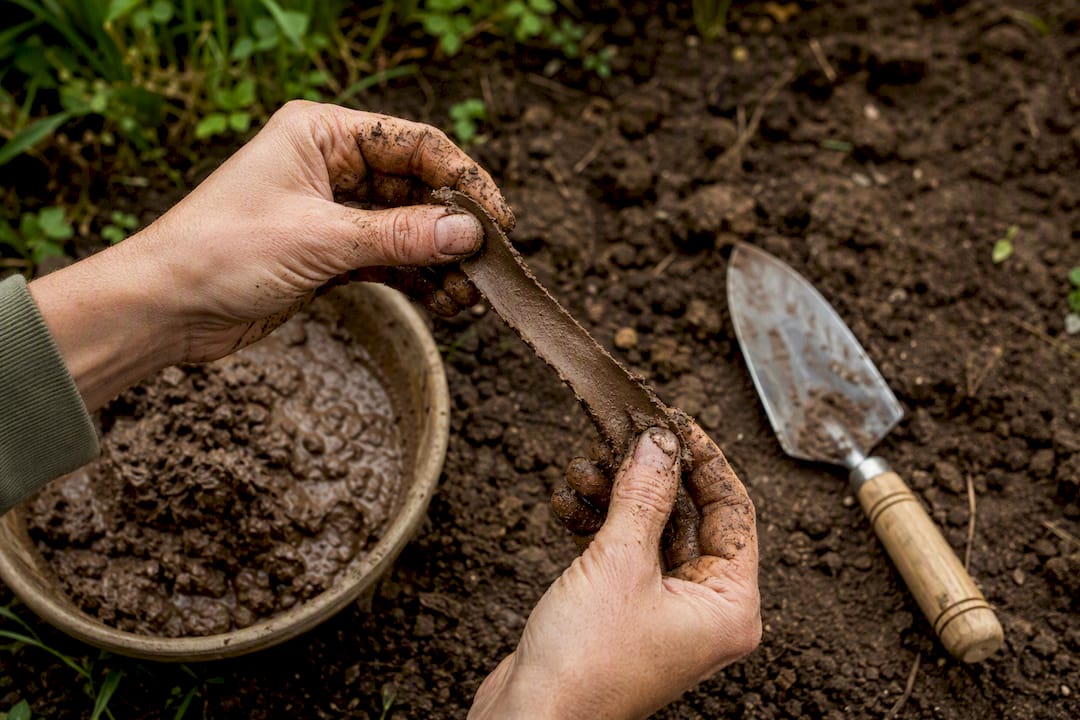
The squeeze test backs this up. Squeeze a moist handful into a fist. Sandy soil crumbles apart the second you open your hand. Loam holds a loose shape but breaks with a light poke. Clay holds a tight, almost rubbery ball that barely deforms.
A few things worth checking beyond texture:
- Drainage speed. Dig a hole about 12 inches deep, fill it with water, and time how fast it drains. Clay often takes hours; sandy soil disappears in minutes.
- Surface crusting. A hard, cracked crust after rain that resembles cracked mud is a clay signature.
- Color and smell. Grayish, sour-smelling soil after a storm suggests standing water and compaction.
If you want harder numbers, particularly on pH or sodium levels, send a sample to your state extension service. This matters most when you suspect a sodic soil situation, which requires a sodium absorption ratio (SAR) test before you reach for any mineral amendment. Most extension labs run this for a modest fee and will hand you a report with actual numbers instead of guesswork.
Why Clay Behaves the Way It Does
Clay particles are microscopically flat and stack together like wet playing cards. That structure is why soils running above roughly 30% clay content drain slowly and resist root penetration. It’s also why clay holds onto nutrients so well.
That trade-off is the whole story of clay soil gardening: what makes it frustrating in spring is often what makes it valuable in August.
The upside:
- Holds nutrients tightly, so fewer trips to fertilize
- Retains moisture longer during dry spells, giving plants a buffer other soils don’t have
The downside:
- Drains slowly and can suffocate roots if overwatered
- Compacts easily under foot traffic or heavy equipment
- Warms up slower in spring, delaying planting
- Crusts and cracks when it dries out
Because clay holds water and nutrients so efficiently, a well-amended clay garden often needs less frequent fertilizing than a sandy one. The catch is water management. Clay’s infiltration rate can run as low as 0.01 to 0.5 inches per hour, which means a fast, heavy watering mostly runs off the surface instead of soaking in.
The Organic-Matter Strategy That Actually Fixes Clay
Forget sand, forget miracle powders. The single most reliable fix for clay structure is organic matter, applied consistently, over time.
Organic matter works because it feeds soil biology. Fungi in the soil produce a compound called glomalin that binds clay particles into stable aggregates, creating the pore space that lets air and water move. That’s a biological process, not a one-time mechanical fix, which is why this needs to be a habit rather than a project.
1. Choose the right material. Well-rotted compost is the workhorse. Leaf mold is nearly as good and often free if you have deciduous trees nearby. Aged manure (never fresh, which can burn roots and introduce weed seed) adds nutrients along with structure. Composted bark works well as a coarser amendment that resists compaction longer than finer compost.
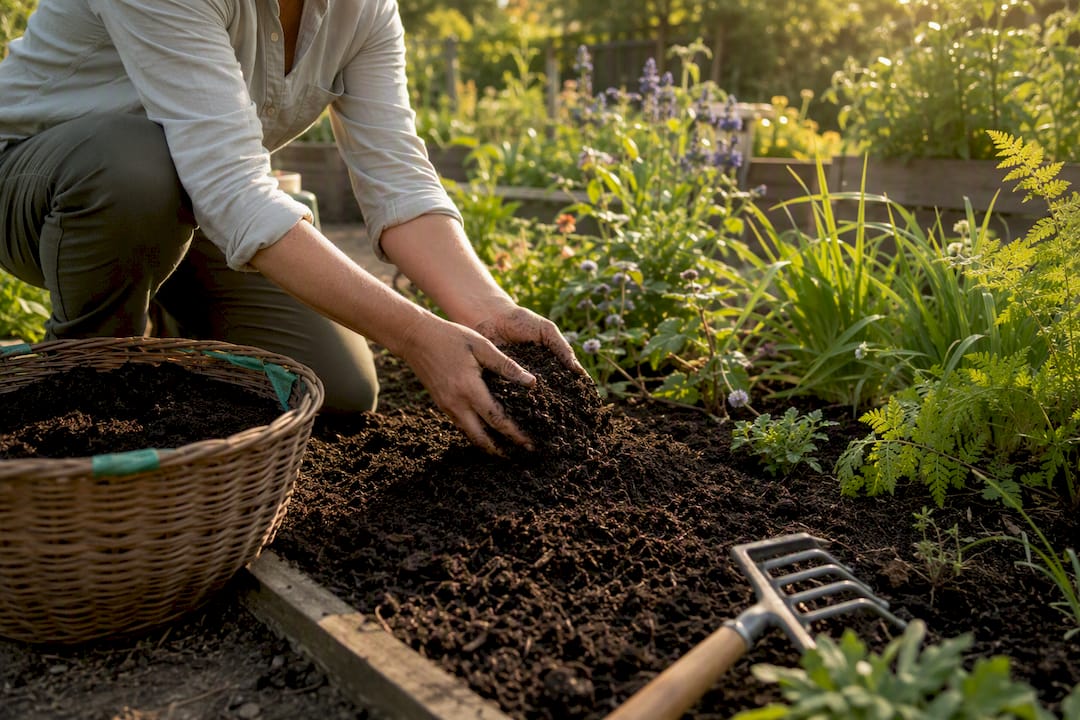
2. Apply the right depth for your situation. For a brand-new bed, spread 2 to 4 inches of compost across the surface and work it into the top 6 to 10 inches of soil. For an established bed with plants already in the ground, skip the digging. Apply 1 to 2 inches as a surface top dressing and let earthworms and soil organisms carry it down over the following months.
3. Time it around your soil’s moisture, not your calendar. Clay that’s too wet compacts under a shovel or tiller, undoing months of work in a single pass. Extension guidance consistently points to late autumn or early winter, or any stretch after the soil has visibly dried out, as the safer windows for a larger incorporation project.
4. Repeat annually. One application softens the top layer. Structural change that reaches deeper into the profile takes repeated seasons of additions, not a single truckload of compost.
5. Skip the tilling on established beds. Once a bed has decent structure, digging it up every year sets you back by disrupting the fungal networks holding those aggregates together.
Pro Tip: Apply your compost top dressing right before a predicted stretch of light rain. The moisture helps worms pull organic matter down into the soil without you lifting a shovel.
Raised Beds, No-Dig, and Getting Watering Right
You don’t have to excavate your entire yard to garden well in clay. Three practical techniques handle most of the daily friction.
Raised beds and mounds sidestep the drainage problem by giving roots several extra inches of loose material to work with before hitting native clay. A raised bed height of several inches is usually enough for vegetables and most perennials; trees and shrubs do better planted directly in amended native soil rather than perched in a shallow raised mound. Fill mixes vary, but a blend of topsoil, compost, and a coarse material like composted bark tends to outperform straight bagged potting soil, which can dry out too fast on its own.
No-dig or sheet mulching is arguably the best-suited method for clay specifically, because it builds structure from the surface down without disturbing the soil biology underneath. Layer cardboard or newspaper over the area, then pile on compost, leaf mold, and mulch. Over a season, the layer decomposes and worms do the incorporation work for you.
Aeration matters most on compacted lawns or beds that see foot traffic. A broadfork works soil gently without inverting layers, which suits smaller garden beds. A core aerator, the kind that pulls plugs of soil out, is better suited to compacted lawn areas rather than planting beds.
- Water slowly and deeply rather than frequently and shallow.
- Let the top inch or two dry before watering again. Clay that’s already saturated stays wet for a long time, and adding more water on top invites root rot.
- Drip irrigation or a soaker hose almost always outperforms a sprinkler on clay, since it gives the water time to soak in instead of running off.
Pro Tip: If water is pooling on the surface within a few minutes of turning on the hose, stop. Wait 20 minutes and resume at half the flow rate. You’ll get more water into the root zone with less runoff.
Mistakes That Undo Months of Good Work
A few habits routinely sabotage otherwise solid clay soil gardening efforts, and they’re worth naming directly.
Adding sand. This is the most persistent myth in the hobby. Mixing sand into clay without amending in genuinely massive volumes tends to create something closer to concrete than loam, since the sand fills gaps between clay particles rather than breaking them apart. Extension research consistently flags this as impractical for home gardens, and the volumes required to actually shift the ratio are far beyond what any homeowner is going to haul in.
The bathtub planting hole. Digging a nice, loose, amended hole and dropping a tree or shrub into surrounding hard clay creates a container effect. Water pools in that loose pocket instead of draining out, and roots often circle inside it rather than spreading. The fix is to amend the entire planting area, not just the hole, so roots have a reason to grow outward into native soil.
Working wet soil. Stepping on or digging into saturated clay compacts it, sometimes for years. If a handful balls up and stays balled up under light pressure, it’s too wet to work. Wait, or work from a board laid across the bed to distribute your weight.
Reaching for gypsum by default. Gypsum only helps in sodic soils, where sodium has displaced calcium on clay particles. Without a SAR test confirming that specific problem, gypsum does little for structure and can throw off your nutrient balance for no real benefit.
Plants That Actually Thrive in Clay
Root architecture decides which plants shrug off clay and which ones sulk. Deep taproots punch through compacted layers; aggressive fibrous roots spread wide and pry structure apart as they grow.
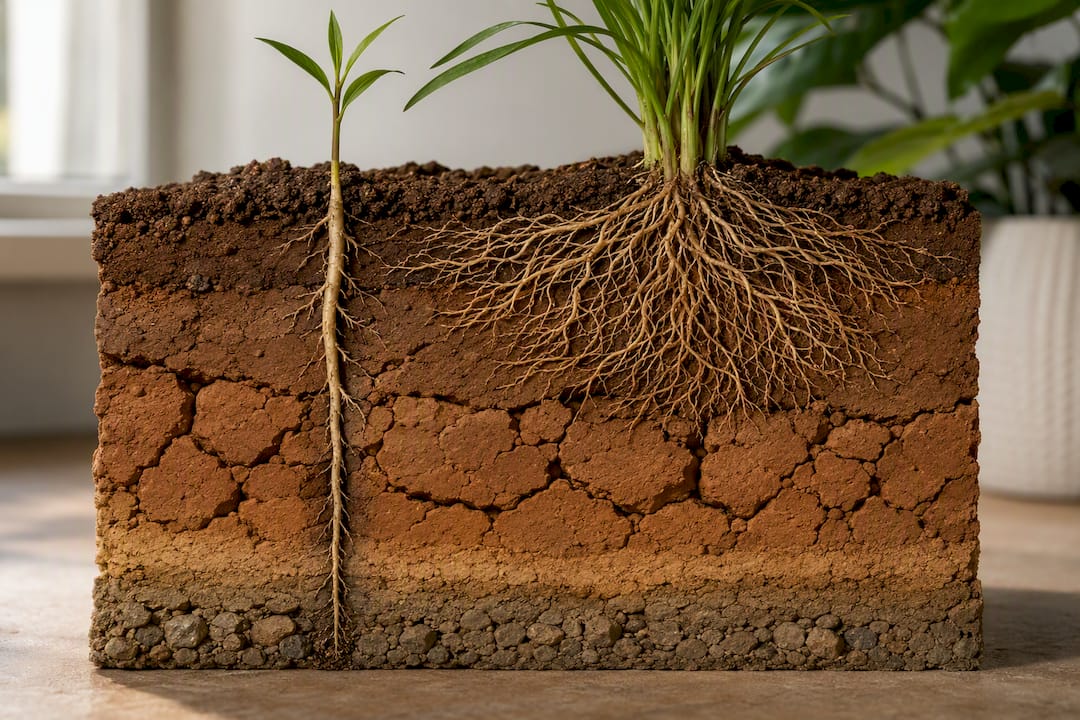
Trees and shrubs: Many maples tolerate heavier soils well, including Norway maple and field maple. Willows like goat willow handle the wet, slow-draining conditions clay often creates. Hydrangeas are another dependable option for anyone gardening on heavier soil.
Perennials: Black-eyed Susans and coneflowers push deep taproots straight through compacted ground. Daylilies and bee balm rely on vigorous fibrous roots that spread and loosen soil as they establish. Tufted hair grass handles damp, heavier ground better than most ornamental grasses.
Vegetables: Tomatoes, cabbage, and squash all perform reasonably well once you’ve built up a season or two of organic matter in the bed.
- Mound vegetable rows slightly to improve local drainage without a full raised bed.
- Space plants a bit wider than seed packets suggest, since clay’s slower drainage means roots compete harder for oxygen.
- Keep a dedicated path through the bed so you’re never tempted to step on planting areas and recompact them.
What to Expect, Season by Season
Clay soil gardening rewards patience more than any other soil type. The first season mostly buys you workability, not a total transformation.
Season one: Expect looser topsoil, easier digging, and noticeably better drainage right after a good rain. Roots still hit resistance a few inches down.
Years two through five: This is where real structural change happens. Annual compost applications gradually deepen the improved layer, aggregate stability increases, and you’ll start seeing earthworm activity throughout the bed instead of just near the surface.
A simple annual rhythm keeps momentum going:
- Early spring or late fall: apply your 1 to 2 inch compost top dressing on established beds.
- Midseason: mulch to protect surface structure and moderate moisture swings.
- Once a year: watch how water drains after a heavy rain and note any standing puddles.
Retest pH every few years, and if you ever suspect a sodium problem, run a SAR test before assuming gypsum is the answer.
What Experienced Gardeners Get Right That Beginners Miss
The single biggest upgrade most gardeners can make is amending the whole bed footprint, not just each planting hole. That bathtub effect shows up years later as stunted, root-bound trees that never quite establish, and by then it’s a much bigger fix.
A plant identification feature can help here in a concrete way: snap a photo of a struggling plant, and it flags whether the issue looks like compaction stress, waterlogging, or a nutrient deficiency, three problems that look nearly identical above ground but need different fixes. Pair that with reminders scheduled around your compost applications, and you’re less likely to let a full season slip by unamended.
Why Clay Might Be the Best Soil You’ll Ever Garden In
Most soil advice treats clay like a problem to be solved once and forgotten. That’s backwards. Clay is a long-term asset that just happens to demand a different rhythm than sandy or loamy soil, and the gardeners who do best with it stop trying to make it behave like something else.
The two habits that matter more than any other technique: annual compost, applied whether or not the bed “needs” it that year, and a no-dig approach on anything already established. Skip both, and you’re re-fighting the same battle every spring. Keep both, and clay’s natural fertility starts working for you instead of against you.
— Dan
Managing Clay Soil Gardening With an AI Assistant
Viridia gives you something a soil bag label never will: care advice matched to your actual climate and soil type, not a generic average. Snap a photo of any plant you’re considering for that heavy clay bed, and the app tells you whether it’s likely to sulk or thrive there before you’ve spent money on it.

Combine that with the manual work in this guide and you get a practical system. Use Viridia’s photo identification to confirm a plant before buying it, then let its care tips guide watering frequency for your specific soil rather than a one-size-fits-all schedule. The health diagnosis feature is particularly useful for clay gardeners, since waterlogging stress and nutrient lockout can look similar at first glance, and catching the difference early saves a plant. Set a recurring reminder for your compost top dressing so it doesn’t slip your mind between seasons, and browse the plant catalog for species suited to heavier soils, including options like aspen and boxwood. If you’re planning a full bed redesign around your clay, the custom garden planning tool can help you map it out. Try the free tier at Viridia and see how it fits your existing routine before upgrading.
Where to Learn More
For deeper reading, the Utah State University Extension guide to clay soils covers testing and amendment in detail, and Oregon State Extension breaks down why sand additions backfire. Contact your local extension office directly for soil testing, including SAR analysis if you suspect sodic conditions.
Sources
- Gardening in clay soils — Utah State University Extension
- Clay soil challenges and solutions — Oregon State Extension
- Improving clay soils for better gardens — N.C. Cooperative Extension