Knock Down Aphids in Two Weeks: Hose, Soap, AI Diagnosis for Gardeners
The fastest safe fix for most aphid problems is a hard water spray to knock the colony off the plant, followed by insecticidal soap or horticultural oil on whatever survives. Nonchemical methods clear the majority of home garden outbreaks within a couple of weeks. Repeat contact sprays every several days for a few rounds. Save stronger chemical options for large woody plants that won’t respond to spraying, or vegetable crops where aphids threaten to spread a virus.
TL;DR:
- Using a strong water spray to dislodge aphids is the fastest method, combined with insecticidal soap or horticultural oil if needed, especially on large or valuable plants.
- Early detection involves checking for honeydew, black mold, curled leaves, ant activity, and clustered insects on new growth or leaf undersides.
- Mechanical removal and preventing ant activity are effective first steps, while beneficial insect habitats and reduced nitrogen help maintain natural predator populations.
- Contact insecticidal soaps and oils require repeated applications every 5 to 7 days because they only kill on contact and don’t reach aphids inside curled leaves.
- Stronger systemic or broad-spectrum insecticides should only be used on high-value plants or when other methods fail, and they can harm pollinators if applied during bloom.
Table of Contents
- How to Confirm Aphids and Spot the Signs Early
- What to Do Right Away: Hose Blasts, Squishing, and Pruning
- Insecticidal Soap, Horticultural Oil, and Spot Sprays: When and How
- Encouraging Predators and Fixing Garden Practices
- Systemics and Stronger Insecticides: When They’re Justified
- Scaling Up: Big Shrubs, Trees, and Dormant Oil Timing
- A Simple Monitoring and Prevention Routine
- How Viridia Helps You Diagnose and Track Treatment
- Patience, Records, and the Long Game
- Diagnose and Track Aphid Treatment With Viridia
- Sources
- FAQ
How to Confirm Aphids and Spot the Signs Early
Aphids are soft, pear-shaped insects, usually about the size of a pinhead, ranging from pale green or yellow to black, gray, or pink depending on species. They cluster in tight groups on new growth, flower buds, and the undersides of leaves, which is exactly where most gardeners miss them until the damage is obvious.
You’ll usually notice the fallout before you notice the bug. Look for these signs:
- A sticky film called honeydew coating leaves, stems, or the ground below the plant.
- Black sooty mold growing on that honeydew residue.
- Leaves that curl, pucker, or twist even though they look otherwise green and healthy.
- Ants trailing up and down stems, since they farm aphids for the honeydew.
- Stunted new shoots or a general sense that fresh growth “looks wrong.”
Flip a few leaves over and check for movement. A hand lens helps separate true aphids from thrips or spider mites, both of which cause similar leaf distortion but move and feed differently. Thrips leave silvery scarring and are slender and fast; aphids sit still in clusters and barely move when disturbed.
What to Do Right Away: Hose Blasts, Squishing, and Pruning
Once you’ve confirmed aphids, act within the next day or two. Colonies double fast in warm weather, and early intervention is far easier than late intervention.
- Blast them off. Set your hose nozzle to a firm jet, not a mist, and spray from about a foot away. Hit both the top and underside of every leaf. A forceful water spray dislodges most aphids from sturdy plants, and most can’t climb back up before predators or gravity finish the job.
- Squish the stragglers. For small colonies, a gloved finger swipe or a soft brush wiped along the stem removes what the hose missed.
- Prune out the worst spots. If one shoot tip is curled and packed with aphids, cut it off and drop it straight into a sealed bag rather than the compost pile.
- Break up the ant supply chain. Ants defend aphids from predators in exchange for honeydew, so a sticky barrier band around the trunk, or simply hosing off the honeydew, removes their incentive to guard the colony.
- For houseplants, isolate the infested pot from your other plants first, then wipe stems and leaf undersides with a damp cloth or a dilute soap solution before returning it to the collection.
Pro Tip: Spray in the early morning. Wet foliage dries faster in morning sun, which lowers the risk of fungal disease, and you avoid the leaf scorch that can happen when you spray a plant baking in afternoon heat.
Insecticidal Soap, Horticultural Oil, and Spot Sprays: When and How
Mechanical removal handles a lot of cases on its own, but a heavier colony often needs a contact treatment behind it. Extension guidance ranks these roughly from most to least “organic”: insecticidal soap, horticultural oil, and neem oil, reserving anything stronger for outbreaks that don’t respond.
- Insecticidal soap (potassium salts of fatty acids) breaks down the aphid’s outer coating on contact.
- Horticultural oil, whether petroleum-based or a botanical oil like neem, smothers aphids and their eggs.
- A dilute rubbing alcohol spray works as a quick spot treatment on tougher, waxy-leaved plants that tolerate it well.
Coverage matters more than concentration. Aphids hide on leaf undersides and inside new growth, so a light misting from above does almost nothing. Mix at label strength, test on one leaf first to rule out sensitivity, and skip spraying during heat waves or on a drought-stressed plant, since oils and soaps can scorch foliage under stress.
Statistic Callout: Insecticidal soaps and horticultural oils only kill on contact and leave no residue, which is why extension programs recommend repeating the application every 5 to 7 days for two to three rounds. That interval catches the aphids that hatched after your last spray.
The real limitation: contact sprays can’t reach aphids tucked inside curled leaves or galls. If a shoot is rolled tight around a colony, pruning it off will do more than another round of spray.
Encouraging Predators and Fixing Garden Practices
Nature handles most of the aphid problem once you stop interfering with it. Lady beetle larvae (they look like tiny spiked alligators, nothing like the adult beetle), lacewing larvae, and hoverfly (syrphid) larvae all eat aphids by the dozen. You’ll also spot parasitoid “mummies,” bloated tan or bronze aphid husks left behind after a tiny wasp has laid an egg inside.
To keep those predators around:
- Plant insectary flowers like alyssum, dill, or yarrow to feed adult beneficials.
- Avoid broad-spectrum insecticides, which strip out predators along with the aphids.
- Skip excess nitrogen fertilizer, since it fuels the soft, tender growth aphids prefer to feed on.
- Space plants for airflow and water at the base rather than overhead, which reduces the lush new growth aphids target.
One thing worth knowing before you spend money: buying and releasing mail-order ladybugs rarely works in a small home garden, because most of them simply fly off within a day or two. Conserving the predators already living nearby beats importing new ones.
Systemics and Stronger Insecticides: When They’re Justified
Reach for a stronger product only when mechanical and contact treatments have failed and you’re dealing with a young or high-value plant, a colony heavy enough to distort growth, or a vegetable crop where aphids can transmit plant viruses (a threshold that’s lower than for most ornamentals, since virus damage can’t be undone once it starts).
- Contact insecticides only kill what they touch; systemic products get absorbed into the plant and can take one to two weeks to reach full effect.
- Broad-spectrum insecticides can backfire by killing the predators that would otherwise keep aphid numbers down, sometimes triggering a worse rebound.
- Never spray a plant in bloom. Systemic insecticides move through pollen and nectar, putting bees and other pollinators at risk. Read the label for pollinator warnings and reapplication limits.
- For many systemic products, hiring a licensed applicator is the safer route, especially for anything soil-injected near edible plants.
The IPM approach favors soaps and oils first, saving systemics and broad-spectrum sprays for the genuine exceptions.
Scaling Up: Big Shrubs, Trees, and Dormant Oil Timing
Hand-spraying a 12-foot rose or a mature fruit tree isn’t realistic once aphids spread through the canopy. Start by pruning out the most heavily infested terminal growth. That alone removes a large share of the colony.
- Use a hose-end or backpack sprayer for taller plants, and wear gloves and eye protection when mixing concentrate.
- Apply dormant or delayed-dormant oil in late winter on woody ornamentals; it smothers overwintering eggs and can meaningfully lower the following spring’s aphid pressure, though it won’t help with an active summer infestation.
- If a tree needs a soil-injected systemic or repeated professional treatment, call a certified arborist rather than guessing at concentrations on a mature specimen.
A Simple Monitoring and Prevention Routine
Check susceptible plants twice a week during their spring growth spurt, focusing on new shoots and bud clusters. Give light infestations about three weeks to respond to predators and weather before treating, unless you’re growing vegetables prone to virus spread.
- Scout new growth and leaf undersides twice weekly in spring.
- Log what you find so you know if numbers are rising or falling.
- Cut spring nitrogen and add insectary flowers to reduce pressure before it starts.
- Note dormant-oil timing on repeat-offender shrubs for next winter.
How Viridia Helps You Diagnose and Track Treatment
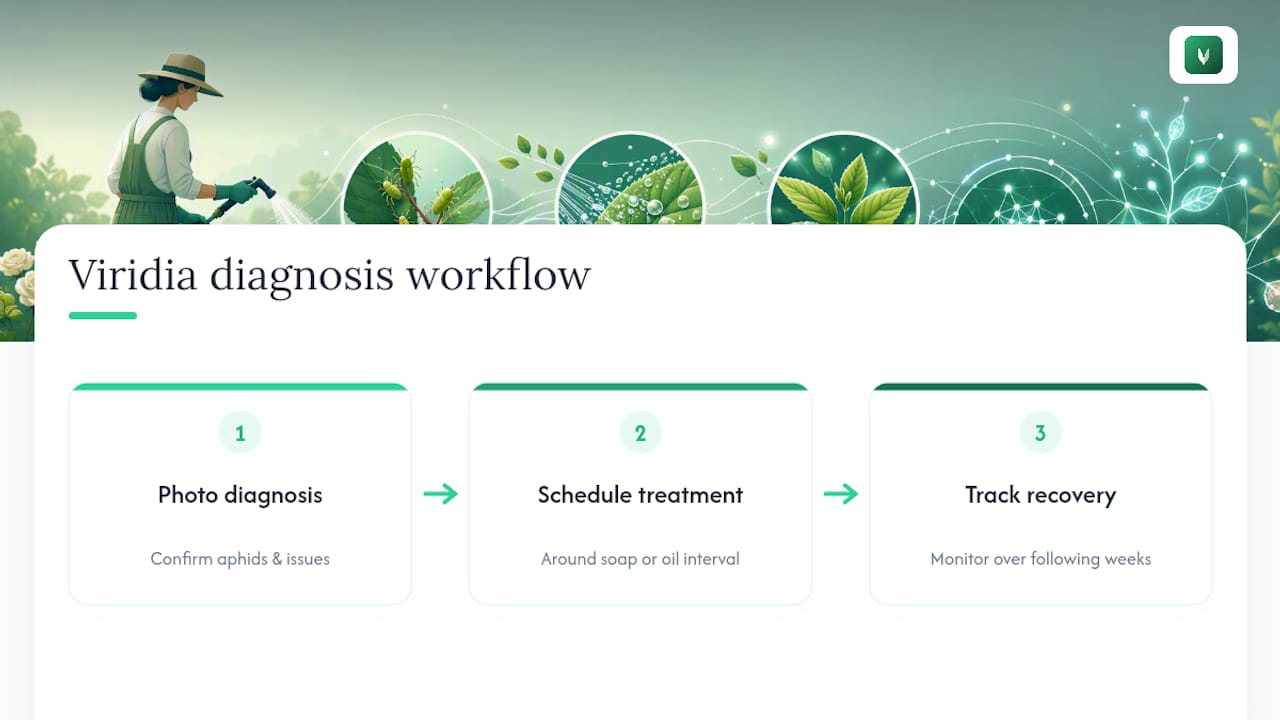
A photo through Viridia can confirm aphids and flag related issues like sooty mold or curled growth you might miss on your own. It then builds a treatment schedule around your soap or oil spray interval and tracks recovery over the following weeks, so you’re not guessing whether round two actually worked.
Patience, Records, and the Long Game
Most outbreaks fade with water, soap, and a few weeks of watching, not spraying. Keep notes each season; the record you build is what makes next year’s response faster.
— Dan
Diagnose and Track Aphid Treatment With Viridia
Viridia is the alternative to guessing your way through pest season: snap a photo, get a treatment plan built around your plant’s specific species and your climate, and let the app remind you when the next spray is due.

Instead of tracking spray dates on a calendar app or a sticky note, log the outbreak inside Viridia’s garden journal and let it flag whether the colony is shrinking or coming back. The free tier lets you try photo diagnosis and basic care tips right away, and if you want the fuller treatment tracking, tailored care calendar, and community advice from other gardeners dealing with the same pest, Viridia Premium runs $48 per year. Start with a photo of the worst-looking leaf on your plant and see what it flags.
Sources
- Aphids / Home and Landscape / UC Statewide IPM Program (UC IPM)
- How do I manage a large outbreak of aphids? — UMaine Cooperative Extension
- Aphids in Home Gardens | University of Maryland Extension
FAQ
What Is the Most Effective Aphid Killer?
There’s no single “best” killer since it depends on the situation, but for most home gardens, a hard water spray followed by insecticidal soap or horticultural oil covers the vast majority of cases. Reserve systemic or broad-spectrum insecticides for stubborn infestations on valuable plants or virus-risk vegetables.
Can Plants Recover From an Aphid Infestation?
Yes, most plants recover fully once the colony is knocked down, since aphid feeding rarely kills a healthy plant outright. New growth typically straightens out within a few weeks, though severely curled leaves usually stay distorted and eventually get replaced by fresh growth.
Does Dawn Dish Soap and Water Kill Aphids?
A weak dish soap solution can kill aphids on contact by breaking down their protective coating, but it’s not formulated or tested the way commercial insecticidal soap is, and it can burn leaves at the wrong concentration. True insecticidal soap made from potassium salts of fatty acids is the safer, tested choice for regular use.
What Do Aphids Hate Most?
Aphids avoid strong-scented plants like alliums, and they steer clear of gardens with a healthy population of ladybugs, lacewings, and parasitoid wasps. They’re also less drawn to plants grown without excess nitrogen, since that fertilizer produces the soft, tender growth aphids prefer.