Six Step Triage to Save Wind Damaged Plants and When to Prune
Most garden plants survive mild-to-moderate wind damage if you act fast on three fronts: check for hazards, water deeply, and clear away broken debris. Full recovery can take weeks to a couple of growing seasons, and the biggest mistake gardeners make is reaching for pruning shears too soon. Hold off on reshaping anything until you know what actually regrows.
TL;DR:
- Most plants recover from wind damage if hazards are assessed first, and pruning is delayed until new growth begins naturally.
- Damage signs include shredded leaves, wind scorch, cracked limbs, and uprooting; wind scorch is common on the windward side, especially in winter.
- Deep, infrequent watering, mulching, and staking only when roots are intact support root recovery and structural stability.
- Use semi-permeable windbreaks and plant in clusters to reduce future wind harm, and stake young trees loosely to prevent weak growth.
- Seek professional help for large trunk splits, root heaves, or trees leaning dangerously toward structures or power lines.
Table of Contents
- Signs of Wind Damage to Plants (and How to Tell It Apart From Disease)
- Immediate Post-Storm Checklist: Safety First, Then Plant Triage
- Repair and Pruning: What to Cut Now, What to Leave Alone
- Reduce Future Wind Damage: Windbreaks, Plant Choice, and Site Setup
- When to Call a Certified Arborist or Utility Company
- A Simple Four-Week Recovery Routine Worth Building
- Track Recovery Species by Species With Viridia
- Sources
- FAQ
Signs of Wind Damage to Plants (and How to Tell It Apart From Disease)
Torn, tattered leaf edges are the giveaway. Wind shreds foliage against itself, branches, and fences, leaving jagged rips that look nothing like the clean, round holes chewing insects leave behind. Windburn shows up differently: a dry, brown crisping along leaf margins, caused by wind pulling moisture out of leaves faster than roots can resupply it. According to UC’s Statewide IPM Program, high winds can desiccate foliage well before root damage becomes visible, which is why leaf scorch often shows up a day or two after the storm has already passed.
Look for these patterns:
- Shredded or tattered leaves, usually worse on the side facing the wind
- Marginal necrosis (brown, crispy edges) known as windburn or wind scorch
- Premature leaf drop, especially on younger growth
- Cracked or split limbs, and “hangers,” broken branches still attached but dangling
- Trunk splits at branch unions
- Uprooting or wind rock, where the base of the trunk has visibly shifted and left a gap or mound in the soil
Evergreens are especially prone to winter wind scorch when strong wind pairs with frozen or dry soil, since the RHS notes roots can’t pull replacement moisture from frozen ground.
Pro Tip: Check the north or west side of a plant first (whichever way your prevailing storm winds came from). Damage almost always concentrates there, so it’s your fastest diagnostic shortcut.
Immediate Post-Storm Checklist: Safety First, Then Plant Triage
Before you touch a single branch, scan the area. Downed power lines, unstable hanging limbs, and split trunks under tension can seriously hurt you, and none of that is worth a few damaged stems.
- Assess hazards from a distance. Walk the perimeter and look up before walking under anything. Never touch a tree or branch that’s tangled with a power line.
- Photograph the damage. You’ll want a record for insurance and for tracking recovery later.
- Clear light, safe debris. Twigs, leaves, and small broken branches you can reach from the ground are fine to remove now.
- Water deeply but infrequently. Storm-stressed plants need help rebuilding root function, not a daily sprinkle. A slow, deep soak encourages roots downward instead of keeping them shallow.
- Mulch around the root zone. A two to three inch layer holds soil moisture and buffers temperature swings while roots recover.
- Upright and stake small plants only if most of the root ball is still in the ground. If a shrub or young tree tipped but its roots are largely intact, gently push it back upright, firm the soil, and stake loosely. If the root plate has heaved and separated from the soil, leave it. Righting a partially failed root system usually finishes the job the wind started.
Skip fertilizer for now. Nitrogen pushes leafy regrowth at exactly the moment your plant needs energy going into roots and wound tissue, not new foliage, according to UNL Extension.
Pro Tip: Snap your damage photos from the same three angles you’ll use in follow-up shots. Consistent angles make it much easier to spot real progress versus wishful thinking.
Repair and Pruning: What to Cut Now, What to Leave Alone
Cut only what’s dangerous or clearly dead. Hanging broken limbs, branches with bark stripped down to bare wood, and anything blocking a walkway are fair game immediately. Everything else waits.
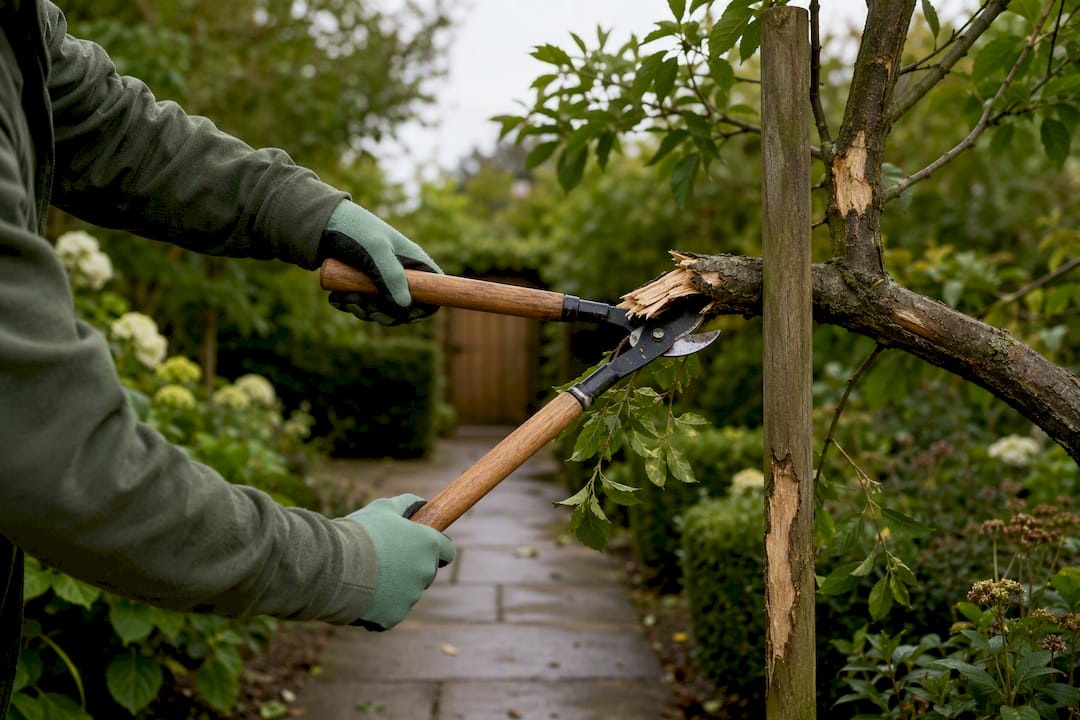
That waiting is the part gardeners struggle with most. A plant that looks lopsided or half bare after a storm often isn’t dying, it’s just resprouting on its own timeline. Iowa State Extension notes that heavy restoration pruning should be delayed after severe storms, since many trees will resprout on their own, and full structural restoration for larger trees can take multiple pruning visits spread across years, not weeks.
When you do prune, technique matters as much as timing:
- Cut just outside the branch collar, the slightly swollen area where a branch meets the trunk, never flush against the trunk itself
- Never leave a stub. Stubs die back and invite decay organisms
- Never top a tree (cutting main leaders down to nubs). It triggers weak, poorly attached regrowth that’s more likely to fail in the next storm
- Use bypass pruners or a sharp pruning saw sized to the branch. Dull tools tear bark instead of slicing it clean
For staking, resist the urge to build a permanent brace. Rigid, long-term staking actually weakens trunk development because the tree never has to build the strength to stand on its own. Loosen and remove stakes within six to twelve months once the plant can hold itself upright in wind.
Keep an eye out for secondary trouble over the following weeks. Wounds and stressed tissue attract opportunistic pests and fungal pathogens that a healthy plant would normally fend off.
Reduce Future Wind Damage: Windbreaks, Plant Choice, and Site Setup
A windbreak works by slowing wind, not blocking it entirely. The USDA and University of Nebraska note that the most effective windbreaks are semi-permeable, letting roughly 40 to 60 percent of the wind pass through. A solid wall or dense hedge sounds protective, but it actually creates violent turbulence on the downwind side, sometimes damaging plants worse than open exposure would.
A well-placed windbreak protects a zone extending several times its own height downwind, so even a single staggered row of shrubs or a permeable fence panel makes a real difference for a home garden.
- Plant wind-tolerant species on the exposed edge of your property to shield more delicate plants behind them
- Group plants in layered clusters rather than isolated specimens; density buffers gusts naturally
- Stake young trees loosely and briefly, never rigidly or for years
- Mulch and irrigate consistently so root systems anchor deeper instead of staying shallow and unstable
- Use temporary netting or fabric screens on vulnerable shrubs ahead of forecast storms
- Move container plants against a wall or into a garage before high wind events
Pro Tip: If you’re planning a new bed or border, sketch your prevailing wind direction before choosing plant placement. Five minutes with a compass app saves years of windburn.
When to Call a Certified Arborist or Utility Company
Some damage is beyond DIY territory. Call a professional when you see a large trunk split, a root plate that has heaved and cracked the soil around it, a tree leaning toward a structure, or big limbs hanging over a roof or power line.
- Look for ISA-certified arborists through the International Society of Arboriculture’s directory or your local extension office
- Ask about emergency response times and insurance coverage before agreeing to storm cleanup work
- Never approach or attempt to cut anything tangled in a downed power line. Contact your utility company first and treat every line as live, since IFAS Extension treats this as the single most important safety rule after any wind event.
A Simple Four-Week Recovery Routine Worth Building
Most damage looks worse on day one than it turns out to be by week four. Patience beats a hasty pruning cut nearly every time, since a plant given water and time will often direct its own recovery better than we can guess for it.
Try this: take a dated photo every week, check soil moisture before each watering, scan leaves and bark for new pest activity, and jot down what changed. It takes five minutes and tells you far more than a single glance ever will. Share what you’re seeing with local growers, too. Wind behaves differently street to street, and a neighbor’s damaged hedge can teach you something your own yard can’t.
— Dan
Track Recovery Species by Species With Viridia
Figuring out whether that scorched maple needs six more weeks or a trip to the arborist gets a lot easier when you know exactly what species you’re looking at and what it needs. An AI assistant can identify plant species from photos and provide health diagnosis with treatment suggestions tailored to local climate and soil conditions, rather than generic advice.

The recovery-tracking tool lets you log those weekly photos from the four-week routine above in one place, with reminders so you don’t forget to check back in. Browse the plant care catalog to look up species-specific storm recovery notes, or start with the free tier to identify your damaged plants today. If you want the full diagnosis and tracking toolkit, Viridia Premium runs $48 per year, or you can lock in lifetime access as a Founding member for a one-time $99.
Sources
- Wind — UC Statewide IPM Program
- Managing storm damage in trees and landscape plants — Lancaster County, UNL Extension
- Managing storm-damaged trees — Iowa State Extension (Yard & Garden)
- How windbreaks work — University of Nebraska / USDA
FAQ
Can Plants Recover From Wind Damage?
Yes, most plants recover from mild-to-moderate wind damage when you address safety hazards, keep up consistent watering, and avoid heavy pruning right away. UNL Extension notes that careful uprighting and hydration can save specimens even after significant limb loss, though full structural recovery for trees can take several growing seasons.
How Can I Protect My Plants From Wind Damage?
Install a semi-permeable windbreak with roughly 40 to 60 percent porosity, since solid barriers create damaging turbulence instead of blocking wind cleanly. Pair that with wind-tolerant plantings on exposed edges, loose staking for young trees, and consistent mulching so roots anchor deeper.
Should I Cut Off Sunburned Leaves on Plants?
Not right away. Leave windburned or scorched leaves in place while the plant redirects energy into root and wound recovery, and only remove foliage that’s fully dead or clearly rotting. Cutting too much too soon strips a stressed plant of the leaf tissue it needs to keep photosynthesizing.
What Should I Do After a Windstorm Damages My Trees?
Check first for downed power lines or unstable hanging limbs, and stay away from anything tangled in utility lines. Once the area is safe, remove hazardous broken branches with clean cuts behind the branch collar, water deeply, and delay major restoration pruning, since Iowa State Extension points out that many trees resprout naturally and heavy pruning too soon can set recovery back.