
Five Photo Checks to Identify Garden Weeds and Decide Whether to Pull

Check three things first: how the leaves attach to the stem, whether the plant spreads by rosette, runner, or upright stalk, and what the roots look like underground. If the plant is unfamiliar or you spot milky sap, thorns, or a suspicious berry, photograph it and leave it alone until you confirm the ID. Small annual seedlings can usually be pulled right away; anything with a spreading rhizome or a thick taproot deserves a delayed, deliberate dig once you know what you’re dealing with.
TL;DR:
- Most weed identification relies on observing plant type, leaf arrangement, and growth habit rather than waiting for flowers to bloom.
- Photographing the whole plant, leaves, stem, roots, and any seed heads in good light improves accuracy, especially for ambiguous or toxic species.
- Management varies by weed life cycle: hand-pulling works for seedlings and annuals, while digging or repeated cutting is necessary for perennials with deep or spreading roots.
- Recognizing common weeds like dandelion, crabgrass, bindweed, and poison hemlock helps determine appropriate removal strategies and safety precautions.
- Addressing underlying soil issues, timing weed removal tasks correctly, and marking problem areas increase long-term weed control success.
Table of Contents
- Quick Checklist to Identify Garden Weeds in the Yard
- How to Identify Weeds Before They Flower
- Weed Life Cycles and Why They Change Your Removal Plan
- Common Garden and Lawn Weeds: Quick Visual ID Guide
- Getting Photo IDs and App Results Right
- Preventing Weeds After You’ve Identified Them
- Should You Pull It or Let It Grow?
- Identify Weeds and Get a Care Plan in One Step
- Sources
- FAQ
Quick Checklist to Identify Garden Weeds in the Yard
You don’t need a botany degree to narrow down what’s growing in your bed. Walk through these five checks in order, and you’ll usually land on a likely family before you ever open an app.
- Classify the plant type. Is it grass-like (narrow, parallel-veined leaves), broadleaf, succulent, or woody? This single split eliminates most wrong guesses immediately.
- Note leaf arrangement and margin. Opposite leaves grow in pairs across from each other; alternate leaves zigzag up the stem. Check whether the edge is smooth (entire), toothed (serrated), or deeply cut (lobed).
- Observe the growth habit. A flat rosette, a creeping mat with above-ground stolons, a climbing vine, and an upright stalk all point toward different weed families.
- Inspect stems and roots if it’s safe to touch. A square stem with opposite leaves often signals the mint family, including ground ivy. A triangular stem usually means sedge, not grass. A shallow, spreading rhizome behaves very differently from a single deep taproot when it comes time to remove it.
- Run a safety check. Look for thorns, milky or colored sap, and any resemblance to known toxic species before you touch it with bare hands.
How to Identify Weeds Before They Flower
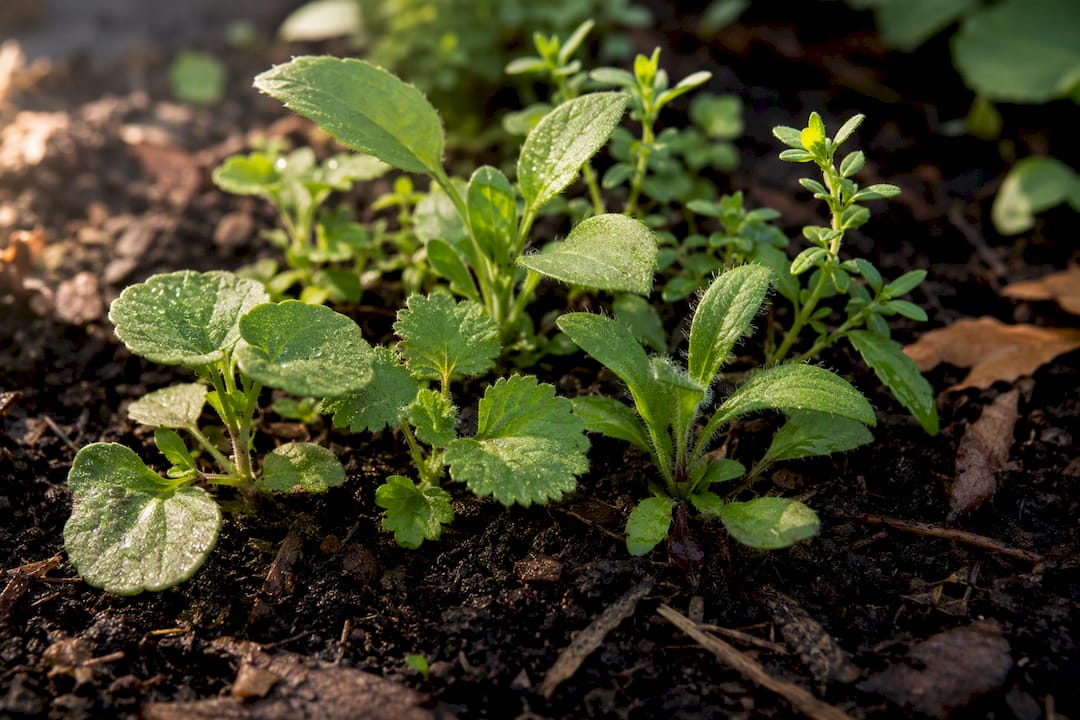
Waiting for a flower to bloom is the slowest way to identify a weed, and by the time it flowers, it may have already set seed. Vegetative traits, meaning leaf shape, leaf arrangement, stem texture, and hairiness, are more reliable for early identification and let you catch a problem at the seedling stage, before it spreads.
A dichotomous key walks you through paired either/or questions (leaves opposite or alternate, stem round or square) until you land on a species. Combined with an illustrated glossary, this method beats scrolling through random photo galleries while hoping for a match, according to the Northeast IPM identification toolbox. University extension photo sets, like the ones maintained by Wisconsin Horticulture, pair clear images with regional notes on how invasive or manageable a species actually is where you live.
When you photograph a mystery plant, capture:
- The whole plant in its growing context, showing scale against a coin, ruler, or your shoe
- A close-up of a single leaf, front and back
- The stem where it meets the soil
- Any flower or seed head present
- The root system, if you can safely dig a small sample
Pro Tip: Take your photos in morning light without flash. Harsh midday sun washes out leaf vein detail that’s often the deciding clue between two similar-looking species.
If two candidate species look nearly identical, or if you suspect something invasive or toxic, send multiple angles and a location note to your county extension office or a master gardener clinic rather than relying on a single app guess.
Weed Life Cycles and Why They Change Your Removal Plan
An annual weed germinates, flowers, sets seed, and dies within one growing season; crabgrass is a classic example. A biennial takes two years, building a rosette the first year and flowering the second, the way burdock does. A perennial comes back year after year from the same root system, as dandelion and Canada thistle both do. Extension guidance ties each category directly to the correct management method, and getting this wrong is the single most common weeding mistake home gardeners make.
- Annual seedlings: hand-pull before seed set; timing matters more than tool choice
- Biennials in rosette stage: dig or pull before the second-year flower stalk forms
- Perennials with a taproot (dandelion): dig out the whole root, or it regrows
- Perennials with creeping rhizomes (bindweed, Canada thistle): these regenerate from tiny root fragments left behind, so repeated cutting to exhaust the root system often works better than a single dig
- Anything unidentified with milky sap, umbrella-shaped flower clusters, or berries: treat as potentially toxic, photograph with gloves on, and confirm before removing by hand
Common Garden and Lawn Weeds: Quick Visual ID Guide
Extension lists like the Chicago Botanic Garden’s roundup of priority weeds to pull now tend to cover the same handful of repeat offenders across most temperate yards. Here’s a scan-friendly rundown, tagged by life cycle: A for annual, B for biennial, P for perennial.
- Dandelion (P): deeply toothed rosette leaves, hollow flower stalk, single thick taproot. Dig the whole root or it regrows.
- Crabgrass (A): low, spreading grass with wide blades; thrives in compacted soil. Pull before late summer seed drop.
- Common purslane (A): reddish stems, thick paddle-shaped leaves, low mat. Edible in salads, so confirm before you toss it.
- Bindweed (P): twining vine, arrowhead leaves, white trumpet flowers. Creeping roots regenerate from fragments; repeated cutting beats a single pull.
- Canada thistle (P): spiny lobed leaves, purple flower heads. Deep, spreading roots; flag for a longer exhaustion strategy.
- Creeping Charlie/ground ivy (P): square stem, scalloped opposite leaves, low creeping mat in shady lawns.
- Plantain (P): broad oval leaves in a flat rosette, tough fibrous roots. Dig with a weeding tool for full removal.
- Chickweed (A): small oval leaves, weak stems, tiny white star flowers. Shallow roots pull easily when moist.
- Clover (P): three-part leaflets, low creeping habit. Often a sign of low soil nitrogen rather than a true problem plant.
- Poison hemlock (B): fern-like leaves, purple-blotched stem, carrot-like root. Highly toxic. Photograph only, wear gloves, and never mow or strim it, since the sap and airborne particles can cause serious reactions.
- Wood sorrel (P): clover-like leaflets, yellow flowers, indicates acidic soil.
- Giant hogweed (P): if you see a plant over 8 feet tall with huge white flower umbels, treat it as a safety hazard and contact your extension office rather than approaching it.
Getting Photo IDs and App Results Right
A photo-based identification is only as good as the photo. Capture the whole-plant habit first, then a leaf close-up, the leaf underside, the stem or node area, and any seed head or flower, plus the root if you can dig a sample safely. Drop a coin or ruler into the frame for scale every time.
- Note the location (lawn, bed, shade, sun), soil moisture, and the time of year in your submission
- Automated tools work well on distinctive, mature plants but struggle with seedlings and lookalike species
- For anything toxic-looking or genuinely unfamiliar, a weed ID clinic or your local extension office gives a human second opinion that catches what software misses
- An AI tool can handle the everyday photo ID and hand you tailored next-step care advice in the same pass, which is worth knowing before you decide whether you need a specialist
Preventing Weeds After You’ve Identified Them
Certain weeds are diagnostic. Crabgrass often points to compacted soil, and sorrel tends to show up where soil pH runs acidic, so fixing the underlying condition does more long-term work than repeated pulling.
- Address the cause: aerate compacted lawn areas, test and adjust pH, and keep bare soil covered with mulch or a dense cover crop.
- Time your work: mulch beds in early spring before seeds germinate, mow lawns at the recommended height to shade out seedlings, and cut any weed before its seed head matures.
- Keep basic tools ready: a dandelion fork or hori hori knife for taproots, hand shears for repeated perennial cutting, and a soil test kit for chronic trouble spots. Escalate to a professional or extension office for anything spreading fast or resistant to hand removal.
Pro Tip: Mark problem patches with a small flag or stake the first time you spot a new weed. Revisit that spot in two weeks; if it’s spread rather than stayed put, you’re likely dealing with a rhizome-spreading perennial, not an annual.
Should You Pull It or Let It Grow?
Not every uninvited plant deserves the fork. A plant growing where you didn’t plant it isn’t automatically a problem; purslane is edible, and dandelion feeds early-season pollinators. Weigh invasiveness and toxicity against pollinator value and your own garden goals before you remove anything you’re unsure about, and use a platform with community features to see how gardeners near you handle the same species.
— Dan
Identify Weeds and Get a Care Plan in One Step
Viridia turns a phone photo into a full plant profile: species identification, a health check if something looks off, and care guidance built around your local climate and soil. For weed questions specifically, it works in three practical ways.

First, it gives you a fast photo-based ID so you’re not guessing between three similar-looking rosettes. Second, once the plant’s identified, it hands you the right next step for your situation instead of a generic removal tip. Third, if you decide to treat a struggling area of lawn or bed instead of just pulling and hoping, its recovery tracking shows whether the fix is actually working over the following weeks. Start with the free tier at Viridia and run your next mystery plant through it before you reach for a shovel, or build a full custom garden plan if you’re tackling a whole bed at once.
Sources
- Guide to weed life cycles
- Weed identification (Wisconsin Horticulture)
- Weeds of the Northeast toolbox (illustrated guide)
- Ten weeds to pull now | Chicago Botanic Garden
FAQ
Is there a free app for identifying weeds?
Several plant ID apps, including Viridia’s free tier, let you photograph an unknown plant and get a species match at no cost, though advanced care and diagnosis features are usually part of a paid plan.
What are some common weeds and their scientific names?
Common examples include dandelion (Taraxacum officinale), crabgrass (Digitaria species), bindweed (Convolvulus arvensis), Canada thistle (Cirsium arvense), and common purslane (Portulaca oleracea); extension photo galleries list dozens more with regional variations.
How do I know which plants in my yard are actually weeds?
A weed is simply a plant growing where you don’t want it, so the label depends on context: check whether it’s edible, pollinator-friendly, or invasive in your area before deciding it’s a problem.
Can I identify weeds online using just a photo?
Yes. Photo-based tools and apps can match most common species from a clear leaf and stem image, but lookalikes and toxic species are worth confirming through a county extension office or a service that offers human backup alongside the automated result.