2–3 Inches of Mulch, Right Pruning: Hydrangea Care for U.S. Gardeners
The core routine is simple: keep the root zone evenly moist, plant your hydrangea where the light and soil match its type, lay down 2 to 3 inches of mulch, and prune according to whether it blooms on old or new wood. Get those four things right and most other problems solve themselves. Before you touch pruning shears, identify your hydrangea type. That single step, more than soil pH or fertilizer, decides whether you see flowers next spring or a plant full of bare stems.
TL;DR:
- Fall planting is optimal in most regions because cooler air and warmer soil promote better root establishment before winter.
- Matching hydrangea variety to site conditions is crucial, with different types thriving in specific sunlight and soil conditions for best growth and flowering.
- Watering should be guided by soil moisture, with deep, infrequent soakings and mulch to retain moisture, especially for newly planted hydrangeas.
- Soil pH influences flower color only in bigleaf hydrangeas, with acidity producing blue blooms and alkalinity resulting in pink; white varieties remain unaffected.
- Pruning timing depends on the type: old wood bloomers need post-flower pruning, while new wood bloomers should be pruned in late winter or early spring to preserve flowering potential.
Table of Contents
- How Do You Plant a Hydrangea for Strong Roots?
- What Is the Right Hydrangea Watering Schedule?
- Can You Change Your Hydrangea’s Flower Color?
- When and How Should You Fertilize Hydrangeas?
- When Should You Prune Hydrangeas, and How?
- What Does a Year of Hydrangea Care Look Like?
- Why Is My Hydrangea Struggling, and What Do I Do?
- How Do You Propagate and Grow Hydrangeas in Containers?
- Balancing Bloom Size, Winter Interest, and Plant Health
- Let Viridia Turn This Guide Into Your Plant’s Own Calendar
- Where to Go for Deeper, Local Hydrangea Guidance
- Sources
- FAQ
How Do You Plant a Hydrangea for Strong Roots?
Fall is the better planting window in most of the country. Cooler air and warmer soil let roots establish before winter, so the plant hits spring ready to grow instead of playing catch up. Spring planting works too, but wait until the danger of frost has passed, and expect to water more closely that first summer.
Matching variety to your site matters more than most gardeners assume. Before you buy, know which group you’re planting:
- Bigleaf hydrangea (Hydrangea macrophylla) wants morning sun and afternoon shade, especially in hot climates.
- Panicle hydrangea tolerates the most direct sun of any type and handles heat well.
- Smooth hydrangea, including the popular ‘Annabelle’, adapts to partial shade and average soil.
- Oakleaf hydrangea prefers dappled shade and offers strong fall color as a bonus.
- Climbing hydrangea needs a sturdy structure and patience. It can take a few years to bloom.
Dig the hole two to three times as wide as the root ball, but no deeper. Planting too deep smothers roots and stunts growth. Backfill with a mix of native soil and compost, water in thoroughly, and space plants according to their mature spread, often 3 to 10 feet depending on the variety. Skip low spots where cold air pools or spots hammered by prevailing wind.
What Is the Right Hydrangea Watering Schedule?
Forget the calendar. Hydrangeas tell you when they’re thirsty, and the honest signal is soil, not a fixed number of days. Check the top 2 to 3 inches of soil, and water deeply once it’s dry rather than sprinkling on a set weekly schedule.
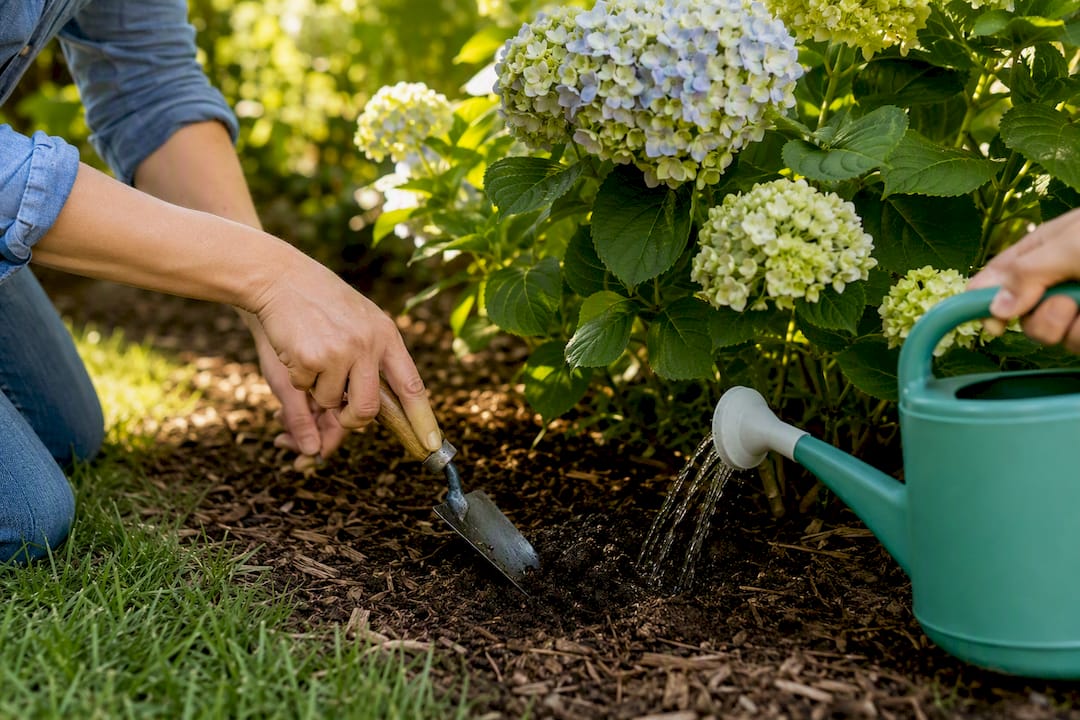
Newly planted hydrangeas need closer attention. Give them steady moisture through their first two years while roots establish, since established shrubs handle short dry stretches far better than transplants do.
A few habits make the biggest difference:
- Spread 2 to 3 inches of mulch to retain moisture and moderate soil temperature, but keep it a few inches off the stems to avoid rot.
- Use drip irrigation or a soaker hose instead of a sprinkler.
- Water at the base in the morning, never overhead in the evening, since wet foliage overnight invites fungal disease.
- Favor deep, infrequent soaks over frequent shallow watering, which builds shallow, weak root systems.
Pro Tip: Stick a finger into the mulch layer near the base of the plant. If it comes out dry past the first two knuckles, it’s time to water. That’s a more reliable gauge than any schedule taped to your shed wall.
Can You Change Your Hydrangea’s Flower Color?
Only if you’re growing a bigleaf hydrangea. Soil pH controls how much aluminum the plant can absorb, and aluminum availability is what actually shifts the pigment between blue and pink. Acidic soil, generally below pH 6, frees up aluminum and pushes flowers toward blue. Alkaline soil above pH 7 locks aluminum away, and the same plant blooms pink.
A simple home soil test kit or a sample sent to your local extension office will tell you where you stand. From there:
- Lower pH gradually with elemental sulfur or an acidifying fertilizer if you want blue.
- Raise pH with garden lime if you want pink.
- Test again before amending further. Many cultivars respond unevenly, and pushing too hard can stress the plant.
White cultivars like ‘Annabelle’ or ‘Limelight’ won’t change regardless of what you do to the soil. Their pigment isn’t aluminum sensitive.
When and How Should You Fertilize Hydrangeas?
Test your soil before adding anything. Hydrangeas don’t need heavy feeding, and too much nitrogen pushes leafy growth at the expense of flowers, which is the opposite of what most gardeners want.
Bigleaf types generally do fine with one light feeding in early spring as new growth starts. Panicle and oakleaf types need even less, often just a top dressing of compost. Smooth hydrangeas rarely need supplemental fertilizer at all in decent soil.
If you’re chasing blue blooms, look for a fertilizer low in phosphate, since phosphorus binds aluminum in the soil and blocks the exact reaction that produces blue color.
When Should You Prune Hydrangeas, and How?
Everything hinges on one question: does this hydrangea bloom on old wood or new wood? Old wood means stems grown the previous year. New wood means stems grown this season. Pruning at the wrong time on an old-wood type is the single most common reason gardeners lose a season of blooms.
A quick field test: in early spring, scratch a stem lightly with your thumbnail. Green underneath means it’s alive and likely to flower. Brown and dry means it’s probably dead and can be cut without risk.
Here’s the rule by type:
- Bigleaf and oakleaf hydrangeas bloom on old wood. Prune right after flowering fades in summer, never in fall or late winter, or you’ll cut off next year’s buds.
- Panicle and smooth hydrangeas bloom on new wood. Prune in late winter or early spring, before growth starts, with no risk to that year’s flowers.
- Reblooming varieties flower on both old and new wood. Take a conservative approach: remove only dead or damaged stems and skip heavy pruning altogether.
When you do cut, use bypass shears for live stems and loppers for thicker old wood, cutting at a 45 degree angle about half an inch to an inch above a healthy bud. Remove dead stems at the base and thin out the oldest canes each year to keep the plant airy.
Pro Tip: When in doubt, don’t prune. Removing only dead wood costs you nothing, while an ill timed haircut can cost you an entire season of flowers.
What Does a Year of Hydrangea Care Look Like?
Care shifts with the season, but the tasks below adapt to your actual weather rather than a fixed date on the calendar, since frost timing and rainfall vary widely across the country.
- Winter: Protect young plants with extra mulch or a burlap wrap in cold regions, and resist any urge to prune old-wood types. Leaving spent flower heads on the plant can actually shield next season’s buds from cold damage.
- Spring: Clear away winter debris, check for live buds using the thumbnail test, transplant if the site isn’t working, and give bigleaf types their one light feeding.
- Summer: Water deeply during hot stretches, provide afternoon shade for stressed plants, and stake varieties with heavy flower heads that flop after rain.
- Fall: Add mulch for winter insulation, decide whether to deadhead for tidiness or leave heads for winter interest, and avoid any pruning on old-wood types.
Why Is My Hydrangea Struggling, and What Do I Do?
Most hydrangea problems trace back to water, not pests. Wilting leaves that recover by evening usually mean drought stress. Leaves that stay yellow and mushy point to overwatering or poor drainage. Bare, blackened stem tips after a cold snap usually mean winter bud kill, not disease.
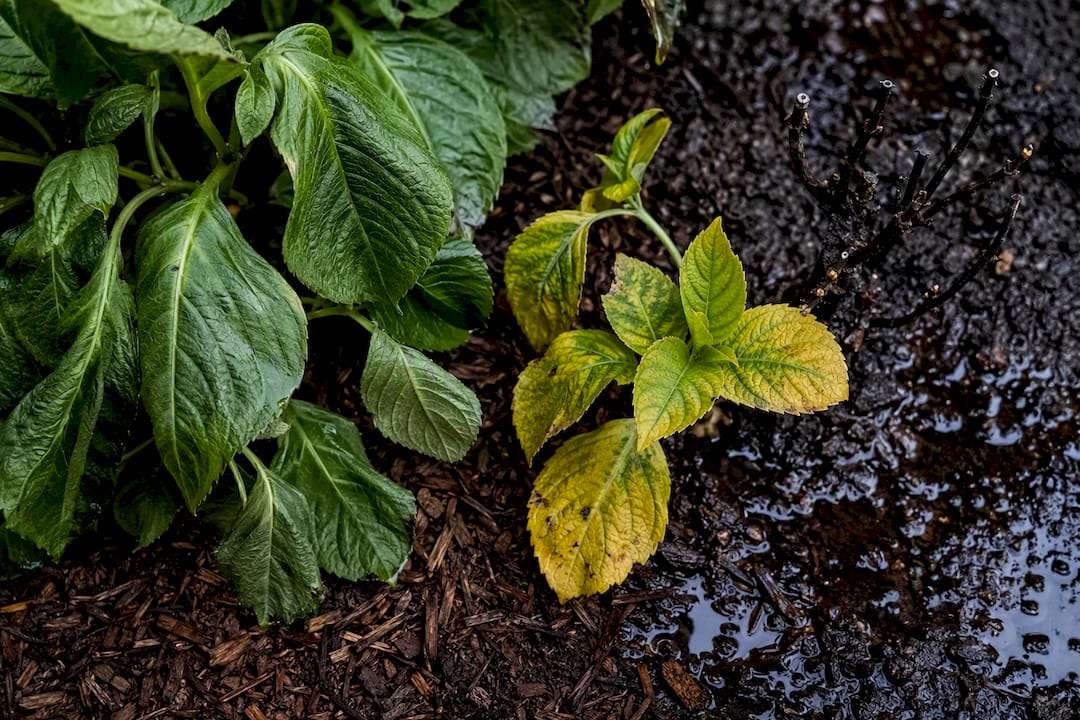
Pests are typically a symptom of a stressed plant rather than the root cause. Aphids and spider mites are the most common culprits, and a hard blast from the hose or a coat of insecticidal soap handles most infestations without reaching for stronger chemicals. Scale insects respond well to horticultural oil applied in early spring before buds break.
Fungal issues like leaf spot and powdery mildew usually trace back to overhead watering or plants crowded too close together with poor airflow. Clean up fallen leaves in fall, space plants properly, and switch to base watering if you see recurring spotting.
- Water-stressed leaves: recover by evening; check soil moisture first.
- Yellow, mushy leaves: back off watering and check drainage.
- Aphids or mites: hose blast or insecticidal soap.
- Leaf spot or mildew: sanitation, airflow, and base watering.
If a problem doesn’t resolve within a week or two of the right fix, a photo sent to your local extension office, or run through a plant identification app, can narrow down what you’re actually dealing with.
How Do You Propagate and Grow Hydrangeas in Containers?
Softwood cuttings are the easiest way to multiply a hydrangea you already love. Take cuttings in spring from non-flowering shoots with three sets of leaves, trim the lower leaves to cut down on moisture loss, and root them under a humidity dome or clear bag until new growth appears.
- Cut a 4 to 6 inch non-flowering shoot and remove the bottom leaves.
- Dip the cut end in rooting hormone and plant it in a well-draining potting mix.
- Cover to hold humidity and keep the soil consistently moist until roots form, usually in 3 to 4 weeks.
- Pot up into a larger container once new leaves appear.
For containers long term, use a peat or bark based potting mix with sharp drainage, since pots dry out faster than garden beds and need more frequent watering. Move potted hydrangeas somewhere sheltered for winter in cold climates, since roots in containers freeze more easily than roots in the ground. If you’re cutting stems for a vase or drying, wait 6 to 8 weeks after bloom so the flower heads have fully matured and hold their shape once dried.
Balancing Bloom Size, Winter Interest, and Plant Health
Perfect blooms and a tidy winter garden are often at odds, and that’s fine. Leaving spent flower heads through winter protects buds on old-wood types even if it looks a little ragged in January.
In marginal climates, a plant’s survival matters more than hitting a flowering deadline. Watch your own hydrangea for a season before making big changes. Local conditions beat generic advice almost every time.
— Dan
Let Viridia Turn This Guide Into Your Plant’s Own Calendar
Everything above changes depending on which hydrangea you’re actually growing and where you live, which is exactly the gap Viridia is built to close. Point your phone at the plant and an app can identify the species from a photo, then build a care calendar around your climate and soil rather than a generic national average.

The health diagnosis feature is the part that saves the most guesswork: photograph a stem or leaf that looks off, and the app flags likely causes and suggests treatment, then tracks recovery over time so you know if the fix worked. For hydrangeas specifically, that means pruning reminders timed to your last frost date instead of a national average, and watering alerts based on your actual local weather. Check the Hydrangea macrophylla care guide on Viridia for species-specific notes, or try Viridia free to identify what’s already growing in your yard.
Where to Go for Deeper, Local Hydrangea Guidance
- OSU Extension Service’s general hydrangea care guide for watering, soil, and pH detail.
- University of Maryland Extension’s pruning guide for old-wood versus new-wood timing.
- FELCO’s pruning technique guide for tool use and cutting angles.
- The Almanac’s planting and growing guide for pest identification.
- YardWoo Lawncare for hands-on local yard maintenance if you’d rather hire out the seasonal upkeep.
Sources
- General care for hydrangeas | OSU Extension Service
- How to prune hydrangeas — FELCO North America
- Pruning hydrangeas | University of Maryland Extension
- How to plant, grow, and care for hydrangeas — Almanac
- Hydrangea care: Light, watering, soil, and pruning by type — The Plant Manual
FAQ
Should Hydrangeas Be Cut Back, and When?
Only if you know whether yours blooms on old or new wood. Bigleaf and oakleaf types get pruned right after flowering, while panicle and smooth types get pruned in late winter or early spring before new growth starts.
Do Hydrangeas Grow Best in Sun or Shade?
It depends on the type and your climate. Bigleaf hydrangeas want morning sun and afternoon shade in hot regions, while panicle hydrangeas tolerate full sun better than any other type.
How Do You Maintain Hydrangeas Year Round?
Keep the root zone consistently moist, maintain 2 to 3 inches of mulch, feed lightly and only after a soil test, and time any pruning to your specific hydrangea’s flowering wood.
How Do You Keep Hydrangeas Blooming?
Avoid pruning old-wood types at the wrong time, since that’s the most common reason blooms disappear. Consistent watering and correct light exposure matter just as much as pruning timing.
Can an App Help Me Identify My Hydrangea Type?
Yes. An app can identify hydrangea species and cultivars from a photo and build a care calendar tailored to your specific plant and local climate.