6–8 Hours Sun: Hibiscus Care for Home Gardeners, Pot or Ground
Hibiscus thrive on 6 to 8 hours of bright light, evenly moist but well-drained soil, and regular feeding with a low-phosphorus, high-potassium fertilizer. That formula holds whether you’re growing a tropical hibiscus on a patio or a hardy hibiscus in a garden bed, though the two types part ways sharply once temperatures drop. Before you change anything about your routine, figure out which one you actually have. It changes almost every decision that follows.
TL;DR:
- Proper identification of tropical versus hardy hibiscus is crucial, as tropical needs indoor warmth and fast drainage, while hardy survives winter outdoors in zones 4 through 9.
- Hibiscus requires 6 to 8 hours of direct sunlight daily, with adjustments for extreme heat through filtered afternoon light to prevent scorching and promote blooming.
- Watering depends on container size and soil mix, with a focus on preventing overwatering; a low-phosphorus, potassium-rich fertilizer supports healthy flowering.
- Potted hibiscus offers mobility and winter control but demands more frequent watering, while in-ground planting suits hardy types but requires careful pot sizing to avoid root rot.
- Using a plant identification app helps diagnose species, monitor health, and tailor care routines, reducing trial-and-error and improving plant outcomes.
Table of Contents
- Tropical vs. Hardy Hibiscus: Why the Distinction Drives Every Care Decision
- How Much Light Does Hibiscus Need to Bloom Well?
- What’s the Best Watering and Fertilizing Routine for Hibiscus?
- Should You Grow Hibiscus in a Pot or in the Ground?
- When and How Should You Prune Hibiscus?
- What Pests and Diseases Affect Hibiscus?
- How Do You Propagate and Repot Hibiscus Without Shocking It?
- How Cold Can Hibiscus Tolerate in Winter?
- Hibiscus Troubleshooting: Symptoms, Causes, and Fixes
- How Viridia Helps You Apply These Hibiscus Care Rules
- A Gardener’s Take: Patience Beats Perfection With Hibiscus
- Try Viridia for Photo ID, Custom Care Plans, and Pest Diagnosis
- Sources
- FAQ
Tropical vs. Hardy Hibiscus: Why the Distinction Drives Every Care Decision
Most hibiscus problems trace back to one mix-up: treating a tropical plant like a hardy one, or vice versa. They look similar in a nursery pot. They behave completely differently once the seasons turn.
Tropical hibiscus (Hibiscus rosa-sinensis) wants warmth year-round. It needs temperatures above roughly 50°F to survive, which means anyone outside frost-free zones has to bring it indoors for winter or grow it as an annual. It blooms on glossy, pointed leaves with flowers that typically last just a day or two but keep coming as long as conditions stay favorable.
Hardy hibiscus (Hibiscus moscheutos) is a true perennial, hardy in USDA zones 4 through 9. It dies back completely in winter, which looks alarming the first time you see it, then returns from the roots and produces enormous mid-summer flowers, sometimes 6 to 8 inches across. Forcing a hardy hibiscus to stay green indoors over winter typically backfires: extension research notes that fighting its natural dormancy tends to stress the plant and reduce next season’s blooms rather than help it.
Here’s a fast way to sort out which one you’re holding:
- Leaf shape: Tropical leaves are glossy and often have a slight point; hardy leaves are broader and more matte, closer to a maple leaf outline.
- Winter behavior: If it drops all its leaves and looks dead at the first frost but comes back in spring, it’s hardy. If frost kills it outright, it’s tropical.
- Bloom size: Hardy flowers tend to run larger, often outsizing tropical blooms on the same size plant.
- Growth habit: Tropical hibiscus stays woody and evergreen in warm climates; hardy hibiscus grows more like an herbaceous perennial, dying to the ground annually.
Get this identification wrong and every other step in this guide, from fertilizing to overwintering, gets applied to the wrong plant.
How Much Light Does Hibiscus Need to Bloom Well?
Hibiscus needs several hours of direct, unfiltered sunlight daily to produce a steady flush of blooms, according to University of Minnesota Extension. Fall short of that window and you’ll notice the plant stretching toward whatever light it can find, growing leggy stems with sparse, small flowers instead of a full, blooming canopy.
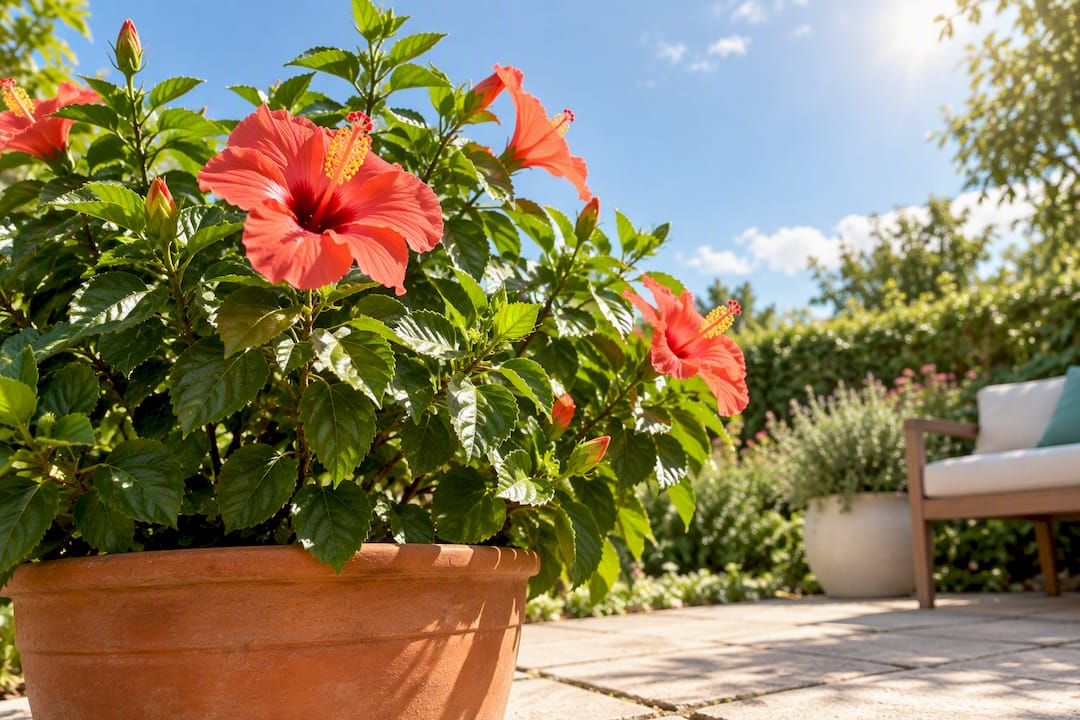
Full sun is the rule, but extreme heat complicates it. In climates that regularly push past 95°F, afternoon sun can scorch leaves and stress roots even in well-watered plants. The fix isn’t shade all day. It’s dappled or filtered light during the hottest afternoon hours, roughly 2 to 5 p.m., while keeping morning and early-afternoon sun uninterrupted.
Watch for these signs your hibiscus is getting too much or too little light:
- Leaf scorch or bleached patches signal too much direct, hot-hour sun without relief.
- Leggy stems with long gaps between leaves point to insufficient light.
- Buds forming but dropping before opening can mean inconsistent light exposure, not just a watering issue.
- Fewer flowers than leaves usually means the plant needs more hours of direct sun, not more fertilizer.
For container plants, a south or west-facing patio spot usually works. Indoors, a bright south-facing window is the minimum. East-facing windows alone rarely deliver enough intensity for strong blooming, even if the room looks bright to your eyes.
Moving a hibiscus outdoors after winter, or indoors before frost, requires acclimation rather than a sudden switch. Shift it gradually over 7 to 10 days, increasing outdoor time a little each day, to avoid shocking the plant into dropping its buds.
Pro Tip: If you’re relocating a hibiscus to a new spot, do it on an overcast day or in the early morning. Direct midday sun on a plant that hasn’t adjusted yet is the fastest way to trigger leaf drop within 48 hours.
What’s the Best Watering and Fertilizing Routine for Hibiscus?
The standard advice, “keep soil evenly moist but never waterlogged,” sounds vague until you break it into actual habits. In containers, that usually means watering when the top inch of soil dries out, which can be daily in summer heat and far less often in cooler months. In-ground hibiscus, backed by more soil volume to buffer moisture swings, often needs watering just two or three times a week during active growth, less once established.
Soil mix matters as much as watering frequency. A porous, organic-rich mix drains fast enough to prevent root rot while still holding enough moisture between waterings. University of Minnesota Extension recommends a simple container formula: two parts potting soil, two parts peat moss, and one part perlite or vermiculite. That ratio balances drainage against water retention better than straight potting soil, which tends to compact and stay soggy at the roots.
Fertilizer is where a lot of gardeners go wrong. High-phosphorus “bloom booster” formulas, the kind marketed for roses and tomatoes, can actually harm hibiscus over time. What the plant wants is the opposite ratio: high potassium, moderate nitrogen, low phosphorus. Extension guidance points to something like a 17-5-24 ratio as a working example, feeding every two to four weeks during active spring and summer growth, then tapering off as growth slows in fall.
Hibiscus fed with excess phosphorus can accumulate it in the soil over repeated feedings, interfering with nutrient uptake and reducing bloom output. Sticking to a fertilizer labeled low in phosphorus avoids that slow buildup.
A quick checklist for the feeding season:
- Feed every 2 to 4 weeks from spring through late summer, using a low-phosphorus, potassium-forward fertilizer.
- Skip or reduce fertilizing in winter, especially for tropical hibiscus overwintering indoors.
- Water deeply enough that excess drains from container holes, rather than a light daily sprinkle.
- Check soil moisture with a finger test before watering on a fixed schedule.
Coffee grounds come up constantly as a home remedy for acidic-soil-loving plants, and hibiscus does tolerate slightly acidic soil. But fresh grounds applied directly can be phytotoxic and compact the soil, according to Washington State University Extension, which recommends composting them first and keeping them to roughly 20% of the compost mix by volume rather than piling raw grounds around the base of the plant.
Should You Grow Hibiscus in a Pot or in the Ground?
The right answer depends on your climate and how much control you want over winter survival. Neither option is universally better. Each trades convenience for something else.
- Containers give you mobility and winter control. You can chase the sun around a patio, move the plant indoors before frost, and swap soil easily if drainage goes bad. The tradeoff is more frequent watering, since potted soil dries out faster than garden beds and has far less volume to buffer temperature and moisture swings.
- In-ground planting suits hardy hibiscus and warm-climate tropical growers. Once established, garden soil holds moisture longer and insulates roots against sudden temperature shifts, which is exactly why hardy hibiscus in zones 4 through 9 handles winter dormancy in the ground without extra protection.
- Pot size affects moisture management more than most gardeners expect. A container that’s too large holds excess soil that stays wet long after the plant has used what it needs, inviting root rot. Extension guidance suggests sizing up pots incrementally rather than jumping to a dramatically bigger pot to maintain better moisture control.
- Root volume changes how fertilizer behaves. In-ground hibiscus, with more soil to dilute nutrients, tolerates a slightly wider margin of error on feeding schedules. Container hibiscus has a much smaller buffer, so over-fertilizing shows up faster as leaf burn or salt buildup at the soil surface.
If you live somewhere with hard frosts and want a tropical hibiscus anyway, a container isn’t just convenient. It’s close to mandatory, since it’s your only realistic path to bringing the plant indoors each winter.
When and How Should You Prune Hibiscus?
Hibiscus blooms on new wood, which means pruning at the right time actually increases flowering rather than sacrificing it. Cut too late in the season, and you remove the very growth that would have carried this year’s buds.
Late winter to early spring, just before new growth starts, is the window for structural pruning. Cut back up to one third of the plant’s overall growth to encourage a bushier shape and more branching points, each of which can eventually carry blooms. Avoid heavier cuts than that in a single season. It can stress the plant and delay flowering rather than accelerate it.
A simple seasonal rhythm:
- Late winter/early spring: Structural pruning, up to a third of growth, removing dead or crossing branches first.
- Summer: Light deadheading of spent blooms, plus pinching leggy stems to encourage branching, not hard cuts.
- Fall: Stop pruning altogether so the plant isn’t pushed into tender new growth right before cold weather arrives.
- Winter (hardy types only): Leave dead stalks in place until spring; they offer some root insulation and mark where new growth will emerge.
Maintenance cuts, snipping a stray shoot or a damaged leaf, can happen anytime. Save the bigger structural work for that late winter window.
What Pests and Diseases Affect Hibiscus?
Aphids, whiteflies, spider mites, and Japanese beetles account for most hibiscus pest complaints, according to UC IPM. Each leaves distinct clues: aphids cluster on new growth and buds, whiteflies scatter in a small cloud when you brush the leaves, spider mites leave fine webbing and stippled yellow spots, and Japanese beetles chew ragged holes straight through petals and leaves.
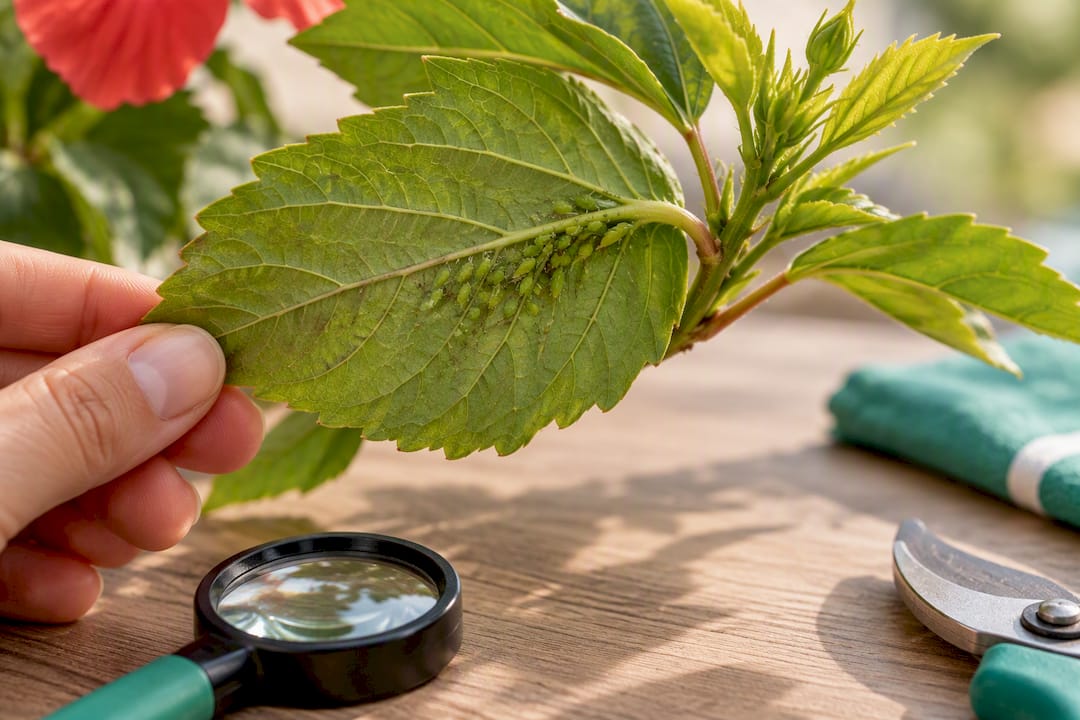
Start with mechanical controls before reaching for anything else. Hand-picking beetles into soapy water, or spraying aphids and mites off with a strong jet of water, handles light infestations without harming the pollinators hibiscus flowers attract. For heavier outbreaks, insecticidal soap or neem oil applied at dawn or dusk keeps you from burning foliage that direct midday sun would otherwise scorch on treated leaves.
Pro Tip: Check the undersides of leaves weekly during peak growing season. Spider mites and early aphid colonies are almost always visible there long before the damage shows up on the leaf surface you’d normally glance at.
Disease shows up differently than pest damage. Powdery mildew appears as a white, dusty coating on leaves in humid, poor-airflow conditions; thinning crowded branches usually solves it faster than any fungicide. Root rot, by contrast, is a watering problem in disguise: yellowing leaves and a mushy, dark root ball mean the soil has stayed wet too long, and the fix is repotting into fresh, well-draining mix rather than watering less and hoping. Left unaddressed, either issue tends to spread to neighboring plants, so isolate an affected container as soon as you spot symptoms.
How Do You Propagate and Repot Hibiscus Without Shocking It?
Hibiscus responds well to cuttings, but the process rewards patience over speed.
- Take a 4 to 6 inch cutting from a healthy, non-flowering stem, cutting just below a leaf node with clean shears.
- Strip the lower leaves and dip the cut end in rooting hormone if you have it, then place it in a moist mix of perlite and peat, or straight into water changed every couple of days.
- Watch for roots within 3 to 6 weeks, keeping the cutting in bright, indirect light rather than direct sun until roots establish.
- Repot when roots crowd the container or growth stalls despite good light and feeding, sizing up just 1 to 2 inches in diameter to keep moisture manageable.
- Transplant outdoors gradually. Acclimate over a week or more, increasing outdoor exposure daily, and water deeply right after planting to settle soil around the roots.
Skipping the acclimation step is the single most common cause of bud drop after a move. Extension research frames it as an environmental shock response, and the fix is stability, not overcorrection: steady light and water, given time, usually bring the plant back around.
How Cold Can Hibiscus Tolerate in Winter?
Tropical hibiscus needs to stay above roughly 50°F. Below that, expect leaf drop, and prolonged exposure to real frost will kill the plant outright. Hardy hibiscus takes the opposite approach: it’s built to go fully dormant, dying back to the ground and surviving winters across USDA zones 4 through 9 without any indoor intervention.
For tropical hibiscus coming indoors:
- Move it to your brightest available window before nighttime temperatures near 50°F, not after the first frost warning.
- Cut back watering frequency, letting soil dry out more between waterings since growth slows indoors.
- Skip fertilizer entirely for the winter months, resuming only once spring growth picks back up.
- Inspect thoroughly for pests before bringing it in, using effective pest-control tactics and monitoring tools to avoid infestations. Aphids and mites that go unnoticed outdoors multiply fast in a warm, dry indoor environment.
Hardy hibiscus needs almost the opposite treatment: leave it alone. A layer of mulch over the root zone after the first hard frost helps in especially cold regions, but resist the urge to dig it up or bring it inside. Come spring, reintroduce tropical hibiscus to outdoor conditions gradually over a week or two once nights stay reliably above 50°F, mirroring the same acclimation process used for any major light or temperature change.
Hibiscus Troubleshooting: Symptoms, Causes, and Fixes
Most hibiscus problems have more than one possible cause, which is why changing only one variable at a time matters. Adjust watering, light, and fertilizer all at once, and you’ll never know which change actually fixed the plant.
| Symptom | Likely Cause | Fix |
|---|---|---|
| Buds form but drop before opening | Sudden move, temperature swing, or inconsistent watering | Stabilize location and watering schedule; avoid moving the plant again for several weeks |
| Yellowing leaves with mushy roots | Overwatering or poor drainage | Repot into fresh, well-draining mix; reduce watering frequency |
| Leggy growth, few flowers | Insufficient light (under 6 hours daily) | Relocate to a spot with 6 to 8 hours of direct sun |
| Scorched or bleached leaf patches | Excess direct sun during peak heat hours | Add afternoon shade between roughly 2 and 5 p.m. |
| Sticky residue or curling new leaves | Aphid or whitefly infestation | Rinse with water; follow with insecticidal soap if it persists |
| Fine webbing, stippled leaves | Spider mites | Increase humidity, rinse foliage, apply neem oil if needed |
If a fix doesn’t show improvement within two to three weeks, or if you’re seeing widespread dieback rather than a single symptom, that’s the point to contact your local Cooperative Extension office rather than keep guessing.
How Viridia Helps You Apply These Hibiscus Care Rules
Knowing that tropical and hardy hibiscus need different winter treatment doesn’t help much if you’re not sure which one is rooted in your yard. Viridia’s photo identification tool solves that first step, confirming species and cultivar so the right feeding and overwintering rules get applied from day one.
From there, the app builds on what you already have going:
- Tailored reminders based on your specific climate and soil flag watering before soil dries out completely or stays soggy too long.
- The health diagnosis feature spots early pest or stress symptoms, like the leaf stippling from spider mites, before damage spreads.
- Recovery tracking lets you see whether a fix, say, stabilizing light after a move, is actually working within days rather than guessing for weeks.
The workflow is straightforward: identify the plant, get climate-specific care steps, set reminders, diagnose issues as they appear, and track recovery over time.
A Gardener’s Take: Patience Beats Perfection With Hibiscus
The core routine boils down to three things done consistently: 6 to 8 hours of light, soil that’s moist but never soggy, and a low-phosphorus fertilizer on a regular schedule. Where most people go wrong isn’t ignorance of the rules. It’s impatience: overcorrecting after one dropped bud, switching fertilizers after one slow week, moving the pot three times in a month chasing “better” light.
Hibiscus tells you what it needs if you watch closely, curling leaves, dropped buds, scorch marks, are all a plant talking. An app like Viridia is useful precisely because it turns that observation into a habit instead of a guessing game. Give a change two to three weeks before judging it. That’s usually where the real answer shows up.
— Dan
Try Viridia for Photo ID, Custom Care Plans, and Pest Diagnosis
Viridia is the alternative to piecing together advice from five different extension PDFs and hoping it applies to your exact climate and soil. Snap a photo to confirm whether you’re growing tropical or hardy hibiscus, get a feeding and watering schedule built around your specific conditions, and run a health diagnosis the moment leaves start yellowing or buds start dropping.

If your hibiscus starts dropping buds after a hot week, an app with diagnostic tools can help narrow down likely causes and provide watering reminders tailored to your soil and climate, rather than relying on generic guidelines. The free tier covers basic identification and care tips, while Viridia Premium, priced at $48 per year, unlocks the full health diagnosis and recovery tracking tools. Browse the full plant catalog to see how detailed care sheets look for species beyond hibiscus, or head to the Viridia landing page to start with a photo today.
Sources
- Hibiscus (University of Minnesota Extension)
- Using coffee grounds in gardens and landscapes (Washington State University Extension)
- Care of Hibiscus rosa-sinensis (Smithsonian Gardens)
- Hardy hibiscus (Clemson Extension / HGIC)
- Hibiscus (UC IPM Home and Landscape)
FAQ
How Do You Take Care of a Potted Hibiscus?
Give it 6 to 8 hours of direct sun, water when the top inch of soil dries out, and use a porous mix like two parts potting soil, two parts peat, one part perlite. Feed every 2 to 4 weeks during active growth with a low-phosphorus, high-potassium fertilizer, and size pots up only 1 to 2 inches at a time to keep moisture manageable.
What Are Common Mistakes People Make With Hibiscus?
The biggest mistakes are treating tropical and hardy hibiscus with the same care rules, overwatering in oversized pots, and moving plants suddenly without acclimating them to new light or temperature. Sudden changes are a leading trigger for bud drop, so gradual transitions matter more than most gardeners expect.
Do Coffee Grounds Help Hibiscus Bloom?
Coffee grounds aren’t a reliable bloom booster, and fresh grounds applied directly can actually be phytotoxic and compact the soil. If you want to use them, compost them first and keep them to roughly 20% of the compost mix by volume rather than applying raw grounds around the plant.
Do Hibiscus Do Better in Pots or in the Ground?
It depends on your climate and hibiscus type. Tropical hibiscus in cold-winter regions almost has to be potted so it can move indoors, while hardy hibiscus generally does better in the ground, where more soil volume buffers winter temperature swings during its natural dormancy.
Can Viridia Tell Me Whether My Hibiscus Is Tropical or Hardy?
Some gardening apps offer photo identification features to help users confirm plant species, which assists in applying appropriate care routines. These apps may also provide tailored reminders and health diagnosis tools to detect issues like bud drop or pest damage early.