Home Gardeners: Three Moves to Protect Plants From Frost Tonight
Frost protection for plants comes down to three moves: cover tender plants with breathable fabric that reaches the ground, water the soil so it holds heat overnight, and bring containers indoors or wrap them if they have to stay outside. Do all three before dusk. Pull covers off at sunrise so the sun can recharge the soil and condensation doesn’t cook your leaves.
TL;DR:
- The effectiveness of frost protection depends on the type of cold event; lightweight covers and deep watering work for clear, calm nights, but are insufficient against windy freezes.
- Heavier frost covers and structures like cold frames or hoop tunnels provide significantly more protection, especially during prolonged or multiple freeze nights, with added insulation such as water jugs or space blankets increasing their efficacy.
- Watering soil deeply before frost nights and using mulch around plant roots can increase soil heat retention and protect plants more reliably than fabrics alone.
- Potted plants require urgent protection since they cool faster; moving them indoors or insulating the pots with wraps and water jugs helps prevent damage better than outdoor covers.
- Active protections such as sprinklers and heaters are risky; continuous sprinkler systems work only if monitored carefully, and lights or heaters must be used with caution to avoid heating or fire hazards.
Table of Contents
- What Kind of Frost Protection Do You Actually Need?
- How Do You Cover Plants Without Damaging Them?
- What Structures Give Plants the Best Long-Term Protection?
- Why Watering and Mulch Matter More Than Most Gardeners Realize
- How Do You Protect Potted Plants From Frost?
- Are Sprinklers, Heaters, and Lights Worth the Risk?
- When Does a Plant Actually Need Frost Protection?
- Your Same-Day Frost Protection Checklist
- How Viridia Helps You Decide What to Protect
- Why Most Frost Advice Skips the Part That Actually Matters
- Get Frost Alerts Before the Cold Snap Hits
- Sources
- FAQ
What Kind of Frost Protection Do You Actually Need?
Not every cold night calls for the same response. A calm, clear night that drops your thermometer near freezing is a radiation frost, the kind where heat simply radiates off plant surfaces into a clear sky. A windy cold front that drags in freezing air for a day or two is an advective freeze, and it behaves completely differently.
That distinction changes your whole game plan. Lightweight fabric and a bucket of warm water can save your tomatoes on a still, radiation-frost night. Against a wind-driven freeze, that same setup does almost nothing, because moving air strips away any heat your soil or covers might trap. Texas A&M AgriLife Extension points out that recognizing which type of event you’re facing, before you spend an hour staking covers, saves wasted labor and false confidence.
Once you know what’s coming, match the method to the scenario:
- Single cold, clear night: a breathable cover plus deep watering earlier in the day is usually enough.
- Multiple nights in a row, or a windy freeze: a structure like a cold frame or hoop tunnel holds up better than a sheet alone.
- High-value plants or a hard freeze forecast: combine a cover with a heat source (water jugs, string lights) rather than relying on fabric by itself.
- Container plants: treat them as more urgent than anything in the ground, since pots lose heat far faster.
Prioritize by what actually matters to you. A prized citrus tree in a pot deserves more effort than a self-seeding annual you’ll replace anyway. Mobility matters too. Anything you can carry inside should go inside first, since no amount of wrapping beats a garage that stays above freezing.
How Do You Cover Plants Without Damaging Them?
The material you grab matters almost as much as whether you cover at all. Spun-bonded row cover fabric, sold at most garden centers as frost cloth or floating row cover, is the standard choice for a reason: it’s light enough to drape directly over foliage, it breathes, and it traps a thin layer of warmer air near the plant.
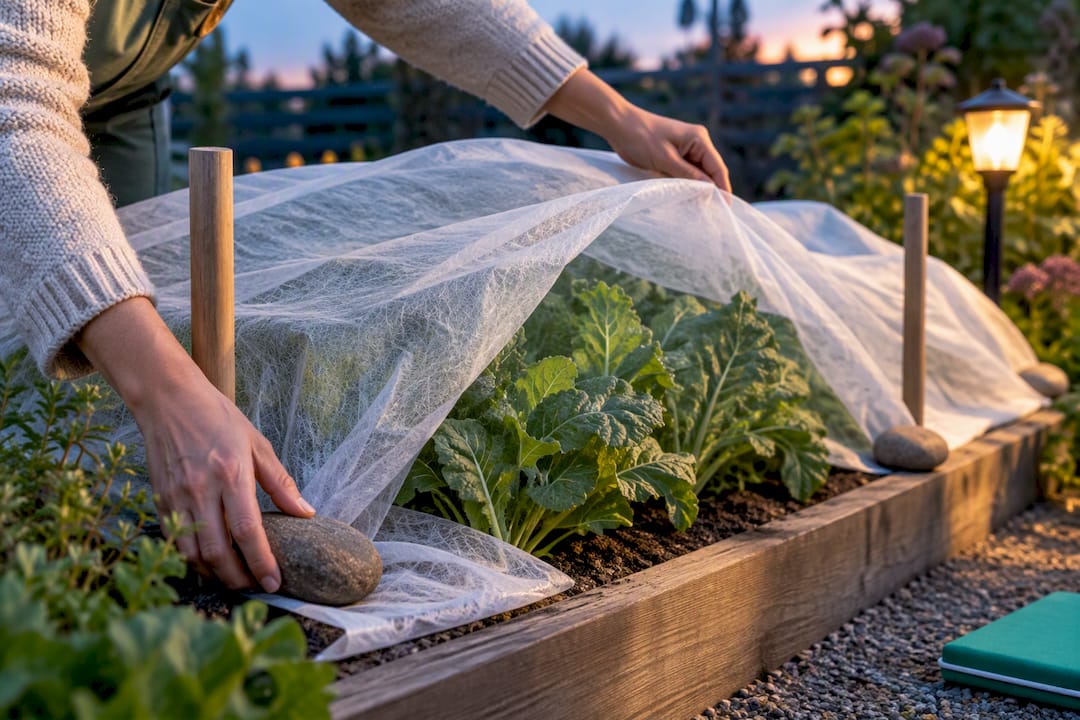
Extension trials give you real numbers to work with. Lightweight fabric covers typically buy you 2°F to 4°F of protection, while heavier floating row covers can push that up to roughly 10°F in some trials. Cold frames built with plastic sheeting land somewhere in between, and Colorado State University Extension has documented similar ranges in its own frost protection trials.
Sheets, blankets, and towels from the linen closet work in a pinch, but they’re heavier and tend to crush low-growing plants unless you hold them up with stakes or a simple wire hoop. Plastic sheeting is trickier. It transmits almost no insulating air layer where it touches a leaf, so any point of contact can actually freeze the tissue it’s resting on. If you use plastic, tent it over a frame so it never touches foliage, and take it off first thing in the morning before the sun turns it into a mini greenhouse.
A few rules apply no matter what material you choose:
- Drape the cover so it reaches the ground on all sides, sealing in the warmer air rising from the soil.
- Anchor the edges with rocks, bricks, or landscape staples. Wind gets under loose fabric and undoes the whole effort.
- Never let a cover sit low enough to crush the plant it’s protecting; use stakes or hoops for anything with delicate stems or buds.
- Skip covering during rain if you can avoid it. A soaked cover loses much of its insulating value and can actually pull heat away through evaporative cooling.
Pro Tip: Double up on cold nights by layering a lightweight row cover under a heavier sheet or an old space blanket. Extension trials have shown that stacking materials, especially with a reflective layer, produces noticeably more protection than either one alone.
What Structures Give Plants the Best Long-Term Protection?
Covers work for a single rough night. Structures earn their keep when cold weather sticks around or you want to extend your growing season by weeks instead of hours.
A cold frame is nothing more than a bottomless box with a clear lid, usually built from scrap lumber and an old window or clear plastic sheeting. A hoop tunnel does the same job with less carpentry: bend lengths of PVC pipe or heavy wire into arcs over a garden bed, then stretch row cover or plastic sheeting over the hoops and clip or bury the edges.
Building and running either one comes down to a few repeatable steps:
- Frame the bed. For a cold frame, build a box slightly taller in back than in front so rain and condensation run off the lid. For a hoop tunnel, space hoops every two to three feet along the row.
- Choose your cover material. Rigid clear plastic or an old storm window works for cold frames; row cover fabric or 4 to 6 mil plastic sheeting works for hoop tunnels.
- Seal the edges. Bank soil, bricks, or boards along the base so cold air can’t sneak in underneath.
- Vent during the day. Prop the lid open or roll back the plastic once temperatures climb, even in winter. Trapped daytime heat and humidity cause more rot and mildew than the cold ever will.
Extension trials on plastic-covered cold frames consistently show gains of 3°F to 6°F over ambient air temperature, enough to carry many cool-season crops through a light freeze without extra help. Adding a space blanket liner or a string of incandescent lights inside the frame pushed protection considerably higher in Colorado State’s Fort Collins trials, though that combination needs daily monitoring so plants don’t overheat once the sun comes out.
Why Watering and Mulch Matter More Than Most Gardeners Realize
Wet soil holds far more heat than dry soil, which is exactly why a good soaking the afternoon before a cold night does real work. Water has a high heat capacity, meaning it releases stored warmth slowly overnight, gently buffering the root zone and the air just above it. UCANR’s cold-weather guidance recommends watering in the late afternoon, giving the soil time to absorb moisture before temperatures drop, rather than watering right at dusk when runoff and cold shock do you no favors.
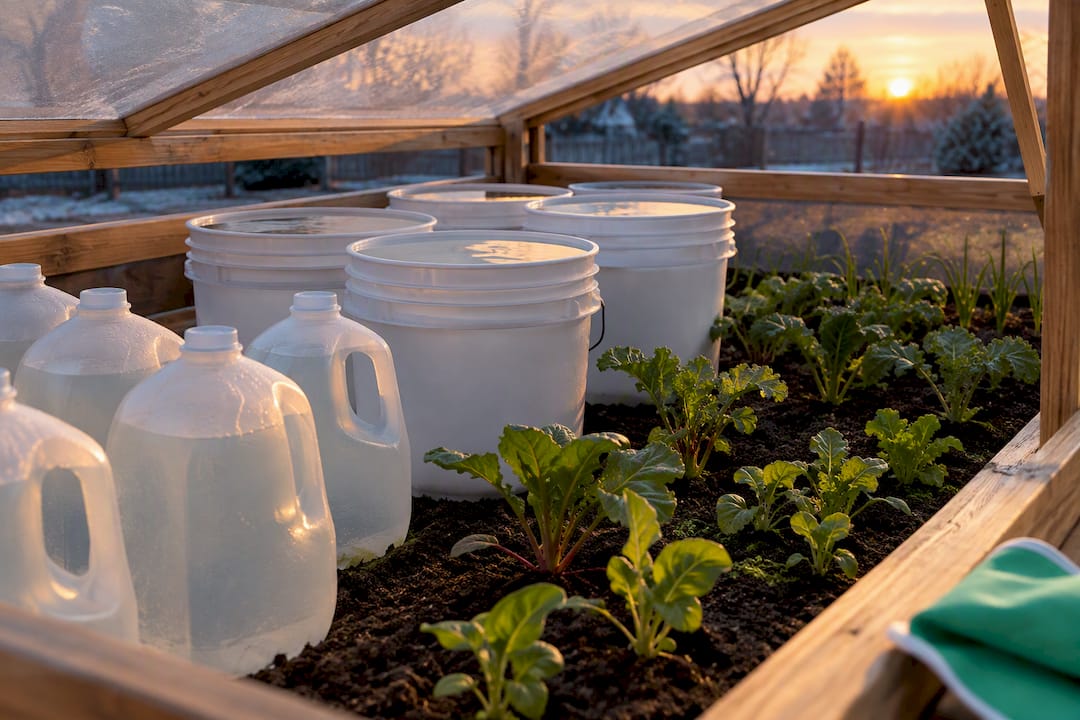
Water jugs and barrels take this same principle further. Fill gallon jugs or five-gallon buckets with water and set them inside a cold frame, hoop tunnel, or even just clustered around vulnerable plants. As the water slowly freezes over the course of the night, it releases stored heat into the surrounding air, buying you a few extra degrees exactly when you need them.
Mulch plays a different but related role. A thick layer of straw, shredded leaves, or bark around the root zone acts like a blanket for the soil itself, slowing how fast stored heat escapes. Extension sources note that combining moist soil, mulch, and heat-retaining objects like walls or water containers can moderate the microclimate around sensitive plants enough to prevent damage from a light frost. Pull mulch back in early spring once the freeze risk passes, since a thick layer left on too long can trap excess moisture and invite rot.
How Do You Protect Potted Plants From Frost?
Containers cool faster than garden soil for a simple reason: there’s far less mass around the roots to buffer temperature swings, and pots are exposed to cold air on every side instead of just the top. That makes potted plants your most urgent priority on a frost night, not an afterthought.
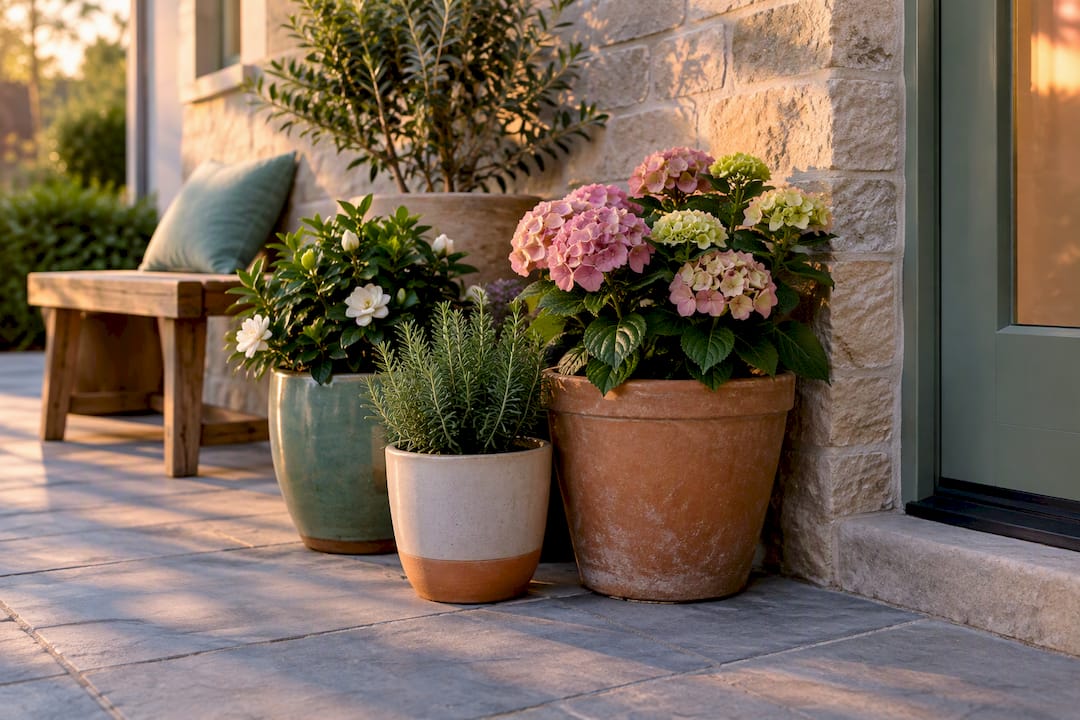
Move pots indoors whenever you can, even into an unheated garage or shed. Extension research from Iowa State notes that an unheated garage holds temperatures above freezing far more reliably than any amount of outdoor wrapping, simply because it blocks wind and radiant heat loss entirely.
When plants have to stay outside, a few tactics compound to make a real difference:
- Cluster pots together and push them against a south-facing wall to cut down on wind exposure and pick up a little radiant heat.
- Wrap the pot itself, not just the plant, in bubble wrap, burlap, or an old moving blanket. The soil in a container freezes from the outside in, so insulating the pot walls protects the root zone directly.
- Add a thick layer of mulch on top of the soil to slow heat loss from the surface.
- Raise pots off cold concrete or stone using pot feet or scrap wood; a slab pulls heat out of a container far faster than a wooden deck does.
- Tuck a filled water jug against the base of the pot and drape a breathable cover over the whole setup for an extra few degrees on the worst nights.
Are Sprinklers, Heaters, and Lights Worth the Risk?
Commercial growers protect entire orchards by running sprinklers all night, and the physics behind it is genuinely clever: water releases heat as it freezes, and that released heat can keep the plant tissue underneath the ice right around 32°F instead of dropping further. Ohio State University’s Ohioline factsheet explains that this only works if the system runs continuously until temperatures rise back above freezing the next morning.
That continuous requirement is exactly why sprinklers are risky for a home garden. Stop the water even briefly, or apply too little of it, and evaporative cooling can drop plant temperatures faster than the cold air alone would have. Add too much and you’re dealing with ice loading heavy enough to snap branches. UF/IFAS Extension categorizes this among active protection methods that demand careful design and reliable monitoring, warning that a poorly planned setup can do more harm than doing nothing at all.
Lights and small heaters carry their own hazards:
- Use only outdoor-rated incandescent string lights inside a cold frame or tunnel. LED lights run too cool to add meaningful warmth, and any light source needs weatherproof wiring and a GFCI outlet nearby.
- Never leave a space heater unattended near dry mulch or plastic sheeting.
- Skip active methods entirely unless you’ve tested the setup beforehand and can monitor it through the night.
Pro Tip: A string of old-style incandescent Christmas lights inside a plastic cold frame is one of the few “active” methods low-risk enough for casual home use. Colorado State’s trials found that pairing lights with a space blanket liner produced dramatically higher temperature gains than either one alone.
When Does a Plant Actually Need Frost Protection?
A frost happens when surface temperatures drop to 32°F or below under calm, clear conditions, often even when your local forecast says a few degrees warmer since cold air pools right at ground level. A freeze is more severe: air temperatures well below freezing, sometimes for hours, and it damages plant tissue far beyond what a cover alone can prevent.
Knowing your plants’ tolerance tells you where to spend your energy:
- Protect first: tomatoes, peppers, basil, squash, most annual flowers, and tender ornamentals like tropical hibiscus. These typically suffer damage in the mid to upper 30s°F.
- Usually fine without help: kale, spinach, pansies, and most established hardy perennials, which tolerate light frost and often improve in flavor after one.
- Reconsider protecting at all: many woody perennials and shrubs actually need cold exposure to enter proper dormancy, and extension guidance notes that over-protecting them can disrupt that cycle.
As a working rule, cover tender plants once nighttime lows are forecast below the mid-30s°F. Once a deep, multi-night freeze is locked in, recognize that fabric and water jugs won’t carry tender plants through it. At that point, moving containers indoors or accepting the loss is more realistic than layering on more covers.
Your Same-Day Frost Protection Checklist
Run through these steps in order once you see a frost warning for tonight:
- Mid to late afternoon: water the soil around vulnerable plants and containers deeply, then gather your covers, stakes, hoops, and any water jugs you plan to use.
- Before dusk: move portable containers indoors or against a sheltered wall, drape covers so they reach the ground, secure every edge against wind, and set filled water jugs near or under the cover.
- Overnight: keep an eye on the forecast and actual temperatures if you can, especially if wind picks up unexpectedly.
- After sunrise: remove all covers, prop open any cold frame lids to vent, and inspect plants for blackened or mushy leaves that signal damage.
How Viridia Helps You Decide What to Protect
Not every plant in your yard needs the same response, and figuring that out at 4 p.m. before a frost isn’t always straightforward. Viridia’s plant identification tool can tell you exactly what you’re looking at from a photo, then pull climate-aware care tips that flag which plants in your specific garden are frost-sensitive and which can ride out the night. Its health-diagnosis feature also tracks recovery afterward, so you know whether a plant bounced back or needs follow-up care.
Why Most Frost Advice Skips the Part That Actually Matters
Most frost advice treats every cold night the same, which is exactly where it goes wrong. The real skill isn’t knowing that covers help. It’s knowing when a light row cover is overkill and when it’s completely useless against a wind-driven freeze that no amount of fabric will stop.
Extension research backs a boring but accurate conclusion: the basics (breathable covers, deep watering, moving containers) handle the vast majority of frost nights a home garden faces. Active methods like sprinklers get outsized attention because they’re dramatic, but they’re the wrong tool for almost every backyard scenario. Save that mental energy for the decision that actually matters, which plants are worth protecting in the first place.
Gardeners also tend to under-water before cold nights, treating irrigation as a summer-only task. Moist soil is one of the cheapest, lowest-effort tools available, and it gets skipped constantly simply because it doesn’t feel like “protection.” Water your beds by mid-afternoon on a frost-forecast day, then worry about fabric and stakes second.
— Dan
Get Frost Alerts Before the Cold Snap Hits
Checking five weather apps and guessing which of your plants actually need covering tonight is exactly the kind of decision fatigue Viridia was built to remove. Viridia Premium sends weather-based reminders tied to the specific plants in your digital garden inventory, so instead of a generic frost warning, you get a nudge that says which pots to move and which beds to cover before dusk.

The Viridia app builds those alerts around the climate and soil data tied to your actual garden, not a generic zip code forecast, and its plant catalog includes specific hardiness notes for thousands of species so you’re not guessing whether that new hydrangea needs a blanket tonight. Viridia Premium is available by subscription, and there is also a lifetime access option for dedicated users. Head to the Viridia site to start on the free tier and see whether the personalized alerts earn a spot in your winter routine.
Sources
- How to Protect Plants from Frost and Freeze | Yard and Garden
- Protecting plants from extreme cold | UCANR blog
- Frost protection and extending the growing season | Colorado State University CMG
- Frost protection systems | Ohio State University Ohioline
- Protecting Plants From Frost: How to Prevent Frost Damage | The Old Farmer’s Almanac
FAQ
Can Plants Survive One Night of Frost?
Most tender plants survive a single light frost, especially if you cover them and water the soil beforehand, since moist covered soil rarely drops much below the low 30s°F overnight. Damage becomes more likely with a hard freeze or multiple consecutive cold nights, particularly for tomatoes, peppers, and other frost-sensitive annuals.
Does Frost Cloth Really Work?
Yes. Extension trials show lightweight frost cloth typically adds 2°F to 4°F of protection, while heavier floating row covers can provide up to about 10°F in some tests. The gain depends on draping the cloth all the way to the ground and removing it during the day so the soil can recharge.
Can I Put Plastic Bags Over My Plants to Protect Them From Frost?
Plastic can help only if it’s tented over a frame so it never touches the leaves, since direct contact transfers cold straight into the plant tissue and can cause worse damage than no cover at all. Remove plastic covers first thing in the morning to avoid overheating once the sun comes out.
How Can I Protect My Potted Plants From Frost?
Move containers indoors, into an unheated garage if nothing else, since pots cool faster than in-ground soil and lose heat from every side. If a pot has to stay outside, wrap the container itself in bubble wrap or a moving blanket, raise it off cold concrete, and pair it with a breathable cover and a water jug for extra insulation. Viridia’s climate-aware care tips can flag which potted plants in your inventory are most frost-sensitive so you know which ones to prioritize first.