50–55°F Rule: Fertilizing Schedule That Follows the Plant
Fertilize when plants are actively growing, not by the calendar. Cool-season lawns get fed in early spring after two or three mows and again in late summer through early fall; warm-season lawns wait until they’re fully green, then feed through summer and stop before dormancy. Vegetable beds, raised beds, and containers each run on their own clock tied to how fast roots establish. Before you spread anything, run a soil test and check soil temperature or green-up, and plan around the 4R framework: right source, right rate, right time, right placement.
TL;DR:
- Most lawns require fertilizing only during active growth periods, with cool-season grasses fed after two to three mows in spring and again in late summer, while warm-season grasses are fertilized after full green-up and stopped before dormancy.
- Vegetable beds and containers need more frequent, lower-dose feeding, with raised beds requiring biweekly fertilization and in-ground beds every 3 to 4 weeks, especially for heavy feeders like tomatoes and squash.
- Container and houseplants should be fertilized on a tight schedule, with diluted liquid feeds every 10 to 14 days in growing seasons, but avoid fertilizing in winter when growth slows.
- Fertilizer application should be based on soil temperature or visible plant green-up rather than fixed calendar dates to prevent waste and plant stress.
- A soil test and biological cues are essential before fertilizing, as overfeeding or applying at the wrong time can harm plants and pollute waterways.
Table of Contents
- Fertilizing Schedule for Lawns: Cool-Season vs. Warm-Season
- Fertilizing Schedule for Vegetable and Flower Beds
- Fertilizing Schedule for Houseplants and Container Gardens
- Building a Schedule That Actually Fits Your Yard
- Your Pre-Application Checklist
- What I’ve Learned Watching Fertilizing Schedules Go Wrong
- The Schedule Should Follow the Plant, Not the Month
- Let Viridia Handle the Fertilizing Calendar for You
- Sources
- FAQ
Fertilizing Schedule for Lawns: Cool-Season vs. Warm-Season
Cool-season grasses (fescue, bluegrass, ryegrass) run on a two-window schedule. The University of Minnesota Extension recommends feeding once the lawn is actively growing and has been mowed two or three times in spring, then again in late summer to early fall when growth picks back up after summer heat. That fall window matters more than most homeowners realize. Root development and next spring’s color depend on it more than the spring feeding does.
Warm-season lawns (bermuda, zoysia, St. Augustine) work opposite. Wait until the lawn is fully green, not just starting to green up, then fertilize through the active summer growth period and stop well before the grass heads into dormancy. Feeding too early stresses roots that aren’t ready to use the nutrients, and feeding too late pushes tender growth right before a frost can hit it.
How often depends on lawn density and grass type. Most home lawns need several applications a year, with the exact frequency based on lawn density and grass type.
- One or two feedings: low-maintenance lawns. Sandy, fast-draining soils are the exception, since they need lighter doses more often.
- Three to four feedings: dense, high-traffic lawns that get mowed often and need steadier nitrogen to recover.
- Skip summer nitrogen in hot regions, especially for cool-season grass. Heat stress plus a nitrogen push is a common way lawns burn or thin out in July.
Statistic Callout: The Illinois Extension advises keeping quick-release nitrogen to no more than one pound per 1,000 square feet per application, splitting the annual total evenly across your scheduled feedings rather than dumping it all at once.
Fertilizing Schedule for Vegetable and Flower Beds
Garden beds don’t run on the same clock as lawns, and they don’t run on one clock among themselves either. Raised beds drain faster and leach nutrients quicker than in-ground soil, so they need feeding more often at lower doses. Containers leach faster still.
- Before planting: work compost or a balanced starter fertilizer into the soil. Phosphorus and potassium barely move once they’re in the ground, so getting them placed at root level before seeds or transplants go in matters more than any later application, according to Oregon State University Extension.
- In-ground beds: feed every 3 to 4 weeks during the growing season, per University of Missouri Extension guidance.
- Raised beds: feed every 2 to 3 weeks, since the looser, faster-draining mix flushes nutrients sooner than native soil.
- Sidedress heavy feeders: corn, squash, and tomatoes benefit from a nitrogen boost about 6 to 8 weeks after transplanting or emergence, then again as fruiting ramps up. Root crops and beans need far less; overfeeding them buys you leafy tops and small roots.
- Stop nitrogen 3 to 4 weeks before your first expected frost. Late-season nitrogen pushes soft new growth that frost kills fast, wasting the fertilizer and stressing the plant right before winter.
Fertilizing Schedule for Houseplants and Container Gardens
Container plants and houseplants share one rule: less, but more often, beats a big dose on a random Sunday. Potting mix drains fast and flushes nutrients out with every watering, which is why containers need feeding on a tighter loop than garden soil.
- Containers: diluted liquid feed every 10 to 14 days during active growth.
- Houseplants: feed only from roughly March through October, when most species are actively putting out new leaves, per University of Connecticut Extension guidance.
- Winter: skip fertilizer entirely for most houseplants. Growth slows or stops, and unused nutrients just build up in the soil.
Pro Tip: If leaf tips turn brown and crispy, you’re probably overfeeding. If growth stalls and leaves stay pale green through the summer, you’re likely underfeeding. Both show up faster in containers than in garden beds because there’s so little soil buffering the mistake.
Building a Schedule That Actually Fits Your Yard
A generic calendar schedule ignores your climate, your soil, and what your plants are actually doing. The 4R Nutrient Stewardship framework fixes that by forcing four decisions every time you fertilize:
- Right source: pick a fertilizer whose nutrient ratio matches what a soil test says you’re missing, not what’s on sale.
- Right rate: apply the amount your soil test or label calls for. More isn’t better past a certain point; it’s runoff and burn risk.
- Right time: apply when plants can actually use the nutrients. Applying at the wrong time can be as wasteful, and as risky for nearby waterways, as applying the wrong amount.
- Right placement: get nutrients where roots can reach them. Phosphorus and potassium worked into planting holes; nitrogen top-dressed where active roots sit.
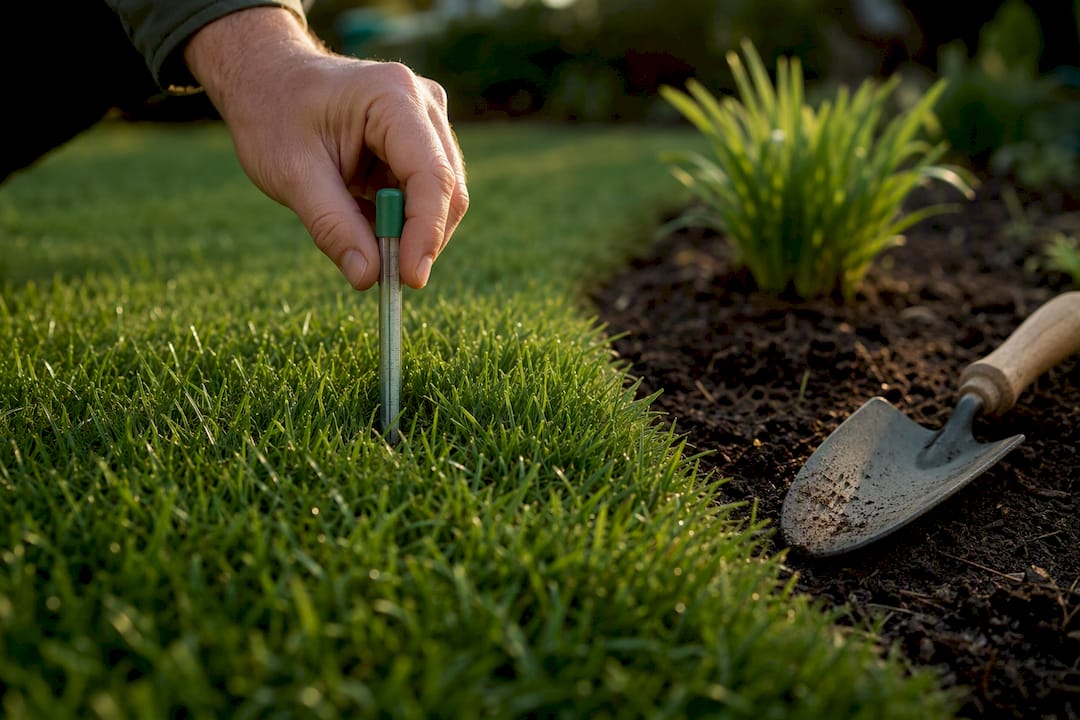
A soil test is the cheapest insurance in gardening. It tells you your actual N-P-K levels and pH instead of guessing, and most state extension offices run one for a modest fee. Skip fixed dates in favor of biological cues: soil temperature around 50 to 55°F or the point where grass or shrubs visibly green up tells you plants are ready to feed. Regional calculators that use your ZIP code and frost dates can sharpen those windows further.
Applying the right amount of fertilizer at the wrong time isn’t a minor miss. It’s the same environmental and plant-health liability as applying the wrong amount altogether.
Never fertilize a plant that’s wilting from drought or scorched by heat. It can’t take up nutrients under stress, and the fertilizer salts sitting in dry soil are more likely to burn roots than feed them. Water first, wait, then feed. And when choosing a product, slow-release granular fertilizer suits lawns and shrubs you don’t want to think about often, while water-soluble feed suits containers and houseplants where you want more control over smaller, more frequent doses.
Your Pre-Application Checklist
Run through this before every feeding, not just the first one of the season:
- Measure the area or container volume so your rate calculation is based on real numbers, not a guess.
- Calculate the product rate from the label, matched against your soil test if you have one.
- Check plant stress: skip the application if beds or lawn are wilted, heat stressed, or bone dry.
- Water beforehand if soil is dry, to protect roots from fertilizer salt burn.
- Log the date and amount somewhere you’ll actually check again, whether that’s a notebook or an app reminder.
Seasonally, the checklist shrinks to three habits: confirm green-up before the first spring feeding, skip or cut back nitrogen during summer heat spikes, and time your last fall or winterizer application to the biological cues covered above rather than a fixed date. Track your running yearly nitrogen total against your region’s extension-recommended cap so a well-meaning extra application in October doesn’t push you over the limit for the year.
What I’ve Learned Watching Fertilizing Schedules Go Wrong
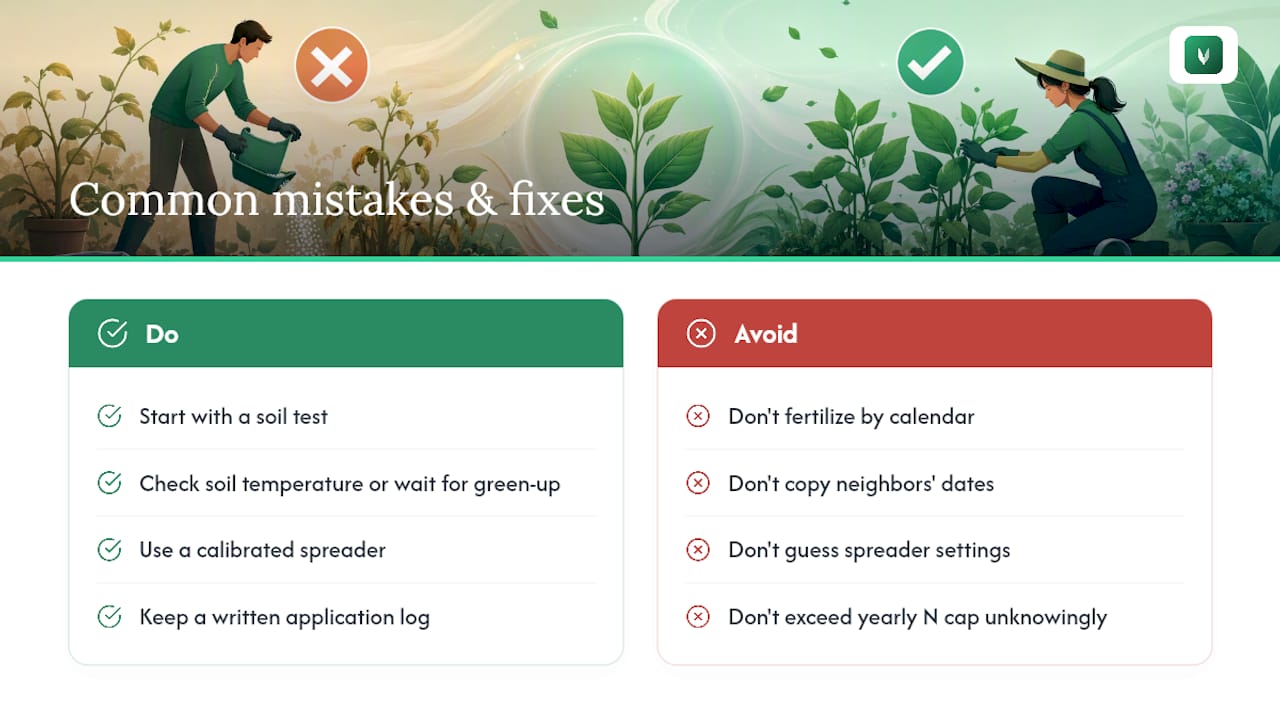
The single most common mistake is fertilizing by the calendar instead of by what the plant and soil are actually doing. I’ve seen homeowners feed cool-season lawns the week of Memorial Day because that’s what their neighbor does, when the grass had already stalled from a heat spike and couldn’t use a pound of nitrogen. The fix isn’t complicated: check soil temperature or wait for visible green-up, not a date on a bag.
A calibrated spreader and a written log solve most of the rest. Guessing at spreader settings is how lawns end up striped with over-fertilized burn marks next to underfed patches. Logging application dates and amounts is how you catch, mid-August, that you’re already close to your yearly nitrogen cap.
Start with a soil test before anything else. It’s the one step that turns a fertilizing schedule from a guess into a plan matched to your actual dirt.
The Schedule Should Follow the Plant, Not the Month
Most fertilizing advice defaults to calendar dates because dates are easy to write down. That’s backwards. A soil temperature reading or a green-up check takes two minutes and tells you something a date on a bag never can: whether the plant in front of you is ready to use what you’re about to give it.
Where conventional advice really falls short is treating lawns, garden beds, and containers as one problem with one schedule. They’re not. A raised bed leaches nutrients on a completely different timeline than a lawn, and a houseplant in a north-facing window doesn’t grow on the same clock as one in full sun. Split by plant type first, then layer in season and biological cues.
If you take one thing from this: run a soil test before you buy fertilizer, and check soil temperature or green-up before you apply it. Everything else in a fertilizing schedule, the rate, the source, the frequency, follows from getting those two things right first.
— Dan
Let Viridia Handle the Fertilizing Calendar for You
Some garden assistant apps let you photo-identify a plant and provide care timing tailored to climate and soil conditions instead of generic date ranges, with weather-aware reminders and maintenance calendars based on your actual growing conditions.

That matters most for the plants where timing is fussiest: containers on a 10 to 14 day cycle, houseplants that need to stop feeding in winter, or a shrub whose ideal window depends on your specific soil and climate rather than a national average. Browse the plant care catalog to check species-specific notes for something like hydrangea or boxwood, or start with a garden plan built around your own space if you’d rather have the schedule built for you than build it yourself. Some services offer personalized calendars and alerts for subscribers; free tiers may include plant identification features to try out.
Sources
- Fertilizing greenhouse and garden crops | University of Missouri Extension
- Houseplant fertilization | University of Connecticut Home & Garden
- Fertilizing your lawn | Illinois Extension
- Fertilizing your garden: Vegetables, fruits and ornamentals | Oregon State University Extension
- 4R Nutrient Stewardship overview | UF/IFAS
FAQ
What Is a Proper Lawn Fertilizing Schedule?
Cool-season lawns get fed in early spring after two or three mows and again in late summer to early fall; warm-season lawns feed after full green-up through summer and stop before dormancy, with most lawns needing one to four applications a year depending on density.
What Month Should You Start Fertilizing?
There’s no single month for every region. Start when soil temperature hits roughly 50 to 55°F or when your lawn or plants show visible active growth, not on a fixed date.
Can I Apply Fertilizer Every Two Weeks?
For containers and some houseplants, yes, a diluted liquid feed every 10 to 14 days is standard. For lawns and in-ground garden beds, that’s too frequent; those run on 3 to 4 week cycles or seasonal windows instead.
How Soon Can You Fertilize Again After Fertilizing?
It depends entirely on what you’re feeding: raised beds handle another application in 2 to 3 weeks, in-ground beds in 3 to 4 weeks, and lawns typically wait until the next seasonal window rather than repeating within the same month.
Can Viridia Build My Fertilizing Schedule for Me?
Viridia generates climate and soil-specific care timing after identifying your plant from a photo, then sends weather-aware reminders so you’re not tracking application windows manually.